寂 (jì) means "quiet; silent" in Chinese. It has 11 strokes with the radical 宀, and is HSK Level 7.
Rated 4.2/5 in difficulty (advanced).
Harder than 52% of HSK Level 7 characters.
Appears in 3+ common words including 寂寞 (jì mò), 寂静 (jì jìng), 沉寂 (chén jì).
Due to its 11 strokes, Hanzi Writer's error detection shows 寂 requires focused practice — most learners need 10+ attempts for consistent accuracy.
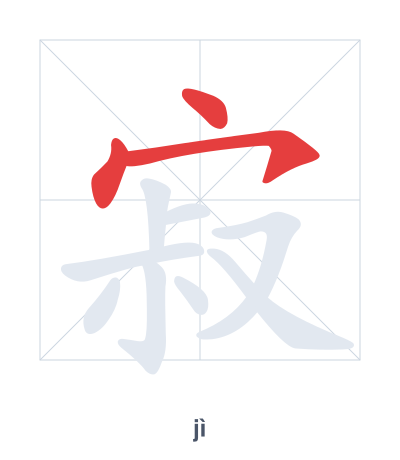
Open Hanzi Writer to see the animated stroke order and practice writing 寂 with real-time feedback.
The character 寂 (jì) is written with 11 strokes. Follow the standard Chinese stroke order: top to bottom, left to right, outside before inside. The radical 宀 is one of its key components.
Practice the correct stroke order with the Hanzi Writer app to see animated stroke-by-stroke guidance with real-time feedback.
寂 means quiet; silent.
As an HSK Level 7 character, 寂 is an intermediate-level character.
寂 is a compound character with the radical 宀 (roof) and 叔 (uncle). The roof suggests an indoor space, and the uncle component evokes the stillness of someone resting, together conveying the sense of quietness or silence.
💡 Memory Tip: Picture an uncle (叔) under a roof (宀) putting a finger to his lips, shushing everyone for quiet.
一个人住会寂寞吗?
yí gè rén zhù huì jì mò ma
Will you be lonely living alone?
深夜的森林很寂静。
shēn yè de sēn lín hěn jì jìng
The forest is very quiet late at night.
全场陷入了沉寂。
quán chǎng xiàn rù le chén jì
The whole venue fell into silence.
Open Hanzi Writer to see the animated stroke order and practice writing 寂 with real-time feedback.
✨ Animated stroke order · Handwriting recognition · HSK-graded practice · Free to use
寂 has the radical 宀 (roof) on top, suggesting a home or building. Below is 叔 (shū, uncle), but here it contributes a phonetic element. Together, the character evokes the idea of a quiet, still home, hence 'quiet' or 'silent'.