噙 (qín) means "to hold in the mouth or eyes" in Chinese. It has 15 strokes with the radical 口.
Rated 4.2/5 in difficulty (advanced).
Appears in 3+ common words including 噙着泪 (qín zhe lèi), 噙着泪水 (qín zhe lèi shuǐ), 噙满 (qín mǎn).
Due to its 15 strokes, Hanzi Writer's error detection shows 噙 requires focused practice — most learners need 10+ attempts for consistent accuracy.
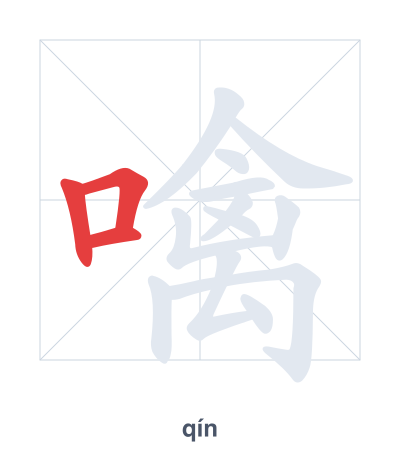
Open Hanzi Writer to see the animated stroke order and practice writing 噙 with real-time feedback.
The character 噙 (qín) is written with 15 strokes. Follow the standard Chinese stroke order: top to bottom, left to right, outside before inside. The radical 口 is one of its key components.
Practice the correct stroke order with the Hanzi Writer app to see animated stroke-by-stroke guidance with real-time feedback.
噙 means to hold in the mouth or eyes.
噙 is a semantic-phonetic compound: the radical 口 (mouth) indicates the action involves the mouth, and the phonetic component 禽 (qín, originally meaning 'bird' or 'fowl') provides the pronunciation. The character literally means 'to hold something in the mouth,' and by extension, it also refers to holding back tears in the eyes.
💡 Memory Tip: Imagine a mouth (口) holding a tiny bird (禽) inside, but instead of a bird, it’s a tear drop—so you’re holding the tear in your mouth or eye.
她的眼里噙着泪。
tā de yǎn lǐ qín zhe lèi
Her eyes were filled with tears.
孩子眼里噙着泪水。
hái zi yǎn lǐ qín zhe lèi shuǐ
The child's eyes were filled with tears.
眼睛里噙满了泪水。
yǎn jīng lǐ qín mǎn le lèi shuǐ
The eyes are filled with tears.
Open Hanzi Writer to see the animated stroke order and practice writing 噙 with real-time feedback.
✨ Animated stroke order · Handwriting recognition · HSK-graded practice · Free to use
噙 is made of the radical 口 (mouth) on the left and 禽 (qín, meaning bird) on the right. The mouth radical directly connects to the idea of holding something in the mouth, while 禽 gives the pronunciation and suggests a bird holding food in its beak.