潜 (qián) means "to submerge; hidden" in Chinese. It has 15 strokes with the radical 氵, and is HSK Level 6.
Rated 4.2/5 in difficulty (advanced).
Harder than 76% of HSK Level 6 characters.
Appears in 3+ common words including 潜水 (qián shuǐ), 潜力 (qián lì), 潜心 (qián xīn).
Due to its 15 strokes, Hanzi Writer's error detection shows 潜 requires focused practice — most learners need 10+ attempts for consistent accuracy.
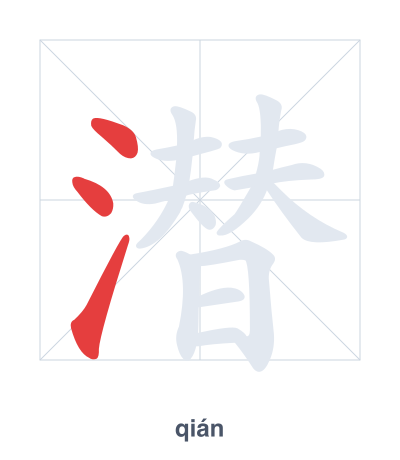
Open Hanzi Writer to see the animated stroke order and practice writing 潜 with real-time feedback.
The character 潜 (qián) is written with 15 strokes. Follow the standard Chinese stroke order: top to bottom, left to right, outside before inside. The radical 氵 is one of its key components.
Practice the correct stroke order with the Hanzi Writer app to see animated stroke-by-stroke guidance with real-time feedback.
潜 means to submerge; hidden.
As an HSK Level 6 character, 潜 is an intermediate-level character.
This character combines the water radical (氵) with 朁 (qián), which originally depicted a person diving underwater or a lid covering something. Together, they convey the idea of being submerged or hidden beneath the water.
💡 Memory Tip: Picture a diver (the right side looks like a person crouching) plunging into water (氵) to stay hidden.
我们去海里潜水吧。
wǒ men qù hǎi lǐ qián shuǐ ba
Let's go diving in the sea.
他很有学习潜力。
tā hěn yǒu xué xí qián lì
He has great potential for learning.
他潜心研究科学。
tā qián xīn yán jiū kē xué
He devoted himself to scientific research.
Open Hanzi Writer to see the animated stroke order and practice writing 潜 with real-time feedback.
✨ Animated stroke order · Handwriting recognition · HSK-graded practice · Free to use
The character 潜 consists of the water radical 氵 on the left and the phonetic component 朁 on the right. The water radical directly links to the meaning of submerging or being hidden underwater. The right part provides the pronunciation and reinforces the idea of going under or being concealed.