断 (duàn) means "to break; to snap; to cut off" in Chinese. It has 11 strokes with the radical 斤, and is HSK Level 3.
Rated 4.2/5 in difficulty (advanced).
Harder than 79% of HSK Level 3 characters.
Appears in 3+ common words including 断了 (duàn le), 不断 (bù duàn), 判断 (pàn duàn).
Due to its 11 strokes, Hanzi Writer's error detection shows 断 requires focused practice — most learners need 10+ attempts for consistent accuracy.
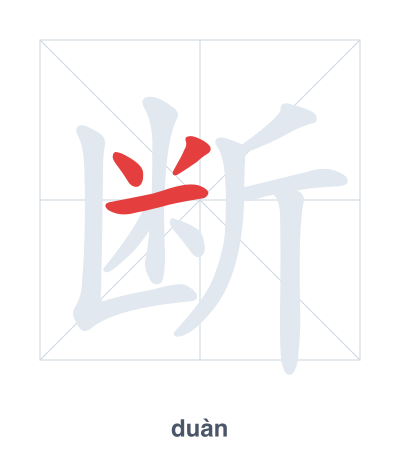
Open Hanzi Writer to see the animated stroke order and practice writing 断 with real-time feedback.
The character 断 (duàn) is written with 11 strokes. Follow the standard Chinese stroke order: top to bottom, left to right, outside before inside. The radical 斤 is one of its key components.
Practice the correct stroke order with the Hanzi Writer app to see animated stroke-by-stroke guidance with real-time feedback.
断 means to break; to snap; to cut off.
As an HSK Level 3 character, 断 is an intermediate-level character.
The character 断 (simplified from 斷) combines 斤 (axe) on the right with a left component derived from 㫃, which originally depicted a severed flag or cloth. The axe represents the action of cutting, while the left part shows something that has been cut apart, together meaning to break or snap off.
💡 Memory Tip: Imagine an axe (斤) chopping a long, wavy piece of cloth (the left side) right through the middle, snapping it in two.
绳子断了。
shéng zi duàn le
The rope broke.
他不断地学习。
tā bù duàn dì xué xí
He studies continuously.
请做出判断。
qǐng zuò chū pàn duàn
Please make a judgment.
Open Hanzi Writer to see the animated stroke order and practice writing 断 with real-time feedback.
✨ Animated stroke order · Handwriting recognition · HSK-graded practice · Free to use
断 is composed of 斤 (axe) on the left and 㫃 (a variant of 㫃 meaning 'to cut' or 'to separate') on the right. The axe (斤) suggests cutting, and the right part reinforces the idea of breaking or severing, together forming the meaning 'to break' or 'to cut off'.