徘 (pái) means "To pace; to be irresolute (bound morpheme)." in Chinese. It has 11 strokes with the radical 彳, and is HSK Level 7.
Rated 4.2/5 in difficulty (advanced).
Harder than 55% of HSK Level 7 characters.
Appears in 3+ common words including 徘徊 (pái huái), 徘徊不定 (pái huái bù dìng), 徘徊者 (pái huái zhě).
Due to its 11 strokes, Hanzi Writer's error detection shows 徘 requires focused practice — most learners need 10+ attempts for consistent accuracy.
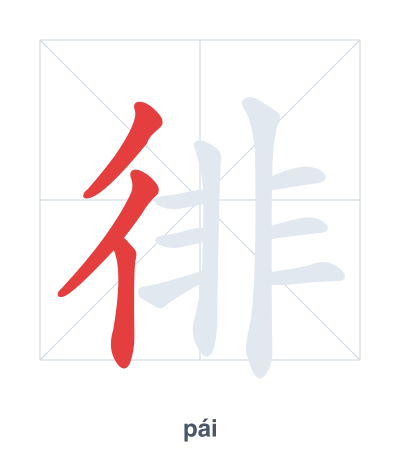
Open Hanzi Writer to see the animated stroke order and practice writing 徘 with real-time feedback.
The character 徘 (pái) is written with 11 strokes. Follow the standard Chinese stroke order: top to bottom, left to right, outside before inside. The radical 彳 is one of its key components.
Practice the correct stroke order with the Hanzi Writer app to see animated stroke-by-stroke guidance with real-time feedback.
徘 means To pace; to be irresolute (bound morpheme)..
As an HSK Level 7 character, 徘 is an intermediate-level character.
The left component 彳 (chi) represents a small step or action, derived from the ancient character for 'street' or 'walking'. The right component 非 (fēi) originally depicted two wings opposing each other, symbolizing contradiction or negation. Together, 徘 conveys the idea of walking back and forth indecisively—taking steps but going nowhere, as if torn between opposites.
💡 Memory Tip: Picture a person (彳) pacing in front of a pair of giant doors (non-committal 非), unable to decide whether to go in or out—just walking left, then right, trapped in hesitation.
他在校门口徘徊。
tā zài xiào mén kǒu pái huái
He is lingering at the school gate.
他对此徘徊不定。
tā duì cǐ pái huái bù dìng
He is wavering about this.
他是一个徘徊者。
tā shì yí gè pái huái zhě
He is a wanderer.
Open Hanzi Writer to see the animated stroke order and practice writing 徘 with real-time feedback.
✨ Animated stroke order · Handwriting recognition · HSK-graded practice · Free to use
The character 徘 combines the radical 彳 (step, on the left) with 非 (false/no, on the right). The radical indicates movement, and 非 adds a sense of opposition or negation, together showing pacing back and forth or hesitation.