徊 (huái) means "To pace back and forth" in Chinese. It has 9 strokes with the radical 彳, and is HSK Level 7.
Rated 4/5 in difficulty (challenging).
Harder than 40% of HSK Level 7 characters.
Appears in 3+ common words including 徘徊 (pái huái), 徘徊不定 (pái huái bù dìng), 徘徊着 (pái huái zhe).
Due to its 9 strokes, Hanzi Writer's error detection shows 徊 requires focused practice — most learners need 10+ attempts for consistent accuracy.
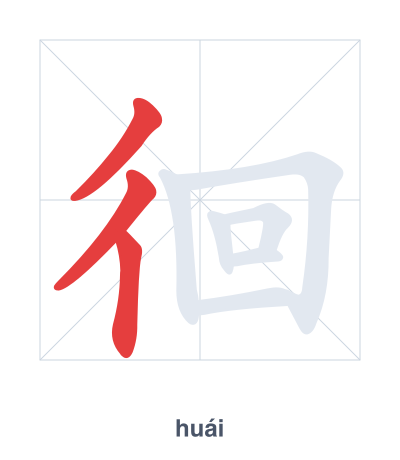
Open Hanzi Writer to see the animated stroke order and practice writing 徊 with real-time feedback.
The character 徊 (huái) is written with 9 strokes. Follow the standard Chinese stroke order: top to bottom, left to right, outside before inside. The radical 彳 is one of its key components.
Practice the correct stroke order with the Hanzi Writer app to see animated stroke-by-stroke guidance with real-time feedback.
徊 means To pace back and forth.
As an HSK Level 7 character, 徊 is an intermediate-level character.
The character 徊 combines the radical 彳 (step or walking) with 回 (to return or circle), visually suggesting the action of walking in a loop or back-and-forth motion. This compound directly conveys the meaning of pacing or hesitating by moving forward and then returning.
💡 Memory Tip: Picture a person (彳) walking in a circle (回) because they're indecisive, pacing back and forth.
他在路口徘徊。
tā zài lù kǒu pái huái
He is pacing at the intersection.
他心里徘徊不定。
tā xīn lǐ pái huái bù dìng
He is wavering in his mind.
他在走廊里徘徊着。
tā zài zǒu láng lǐ pái huái zhe
He is pacing in the hallway.
Open Hanzi Writer to see the animated stroke order and practice writing 徊 with real-time feedback.
✨ Animated stroke order · Handwriting recognition · HSK-graded practice · Free to use
The character 徊 is a left-right structure. The left radical 彳 (chì) means "step" or "walking," hinting at motion. The right part 回 (huí) means "to circle back," together suggesting the back-and-forth movement of pacing or hesitation.