很 (hěn) means "very" in Chinese. It has 9 strokes with the radical 彳, and is HSK Level 1.
Rated 3.5/5 in difficulty (challenging).
Harder than 78% of HSK Level 1 characters.
Appears in 3+ common words including 很好 (hěn hǎo), 很多 (hěn duō), 很快 (hěn kuài).
Due to its 9 strokes, Hanzi Writer's error detection shows 很 requires focused practice — most learners need 10+ attempts for consistent accuracy.
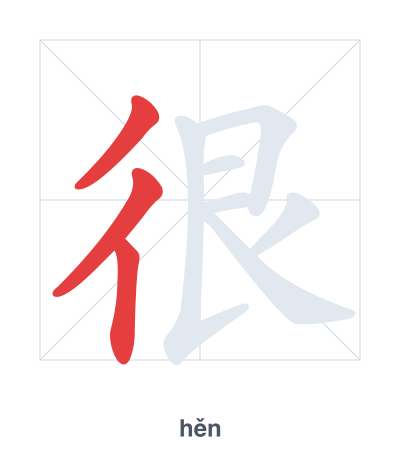
Open Hanzi Writer to see the animated stroke order and practice writing 很 with real-time feedback.
The character 很 (hěn) is written with 9 strokes. Follow the standard Chinese stroke order: top to bottom, left to right, outside before inside. The radical 彳 is one of its key components.
Practice the correct stroke order with the Hanzi Writer app to see animated stroke-by-stroke guidance with real-time feedback.
很 means very.
As an HSK Level 1 character, 很 is among the first characters beginners learn.
很 combines the walking radical 彳 (suggesting movement) with 艮 (gèn, originally meaning 'turning away' or 'obstinate'). In ancient Chinese, it described someone stubbornly refusing to move, which later intensified to mean 'very' as an adverb of degree.
💡 Memory Tip: Imagine a person (彳) walking but stopping short because a giant, very stubborn root (艮) blocks the path, making them exclaim 'Very!' in frustration.
今天天气很好。
jīn tiān tiān qì hěn hǎo
The weather is very good today.
这里有很多人。
zhè lǐ yǒu hěn duō rén
There are many people here.
他跑得很快。
tā pǎo dé hěn kuài
He runs very fast.
Open Hanzi Writer to see the animated stroke order and practice writing 很 with real-time feedback.
✨ Animated stroke order · Handwriting recognition · HSK-graded practice · Free to use
The character 很 is made of two parts: the left radical 彳 (meaning 'step' or 'walking') and the right part 艮, which originally gave the sound. Although the modern meaning 'very' is not directly tied to these parts, the radical 彳 suggests movement, and the character was historically used for actions like 'stubborn' or 'to go against.'