暖 (nuǎn) means "warm" in Chinese. It has 13 strokes with the radical 日, and is HSK Level 3.
Rated 4.2/5 in difficulty (advanced).
Harder than 80% of HSK Level 3 characters.
Appears in 3+ common words including 温暖 (wēn nuǎn), 暖和 (nuǎn huo), 暖气 (nuǎn qì).
Due to its 13 strokes, Hanzi Writer's error detection shows 暖 requires focused practice — most learners need 10+ attempts for consistent accuracy.
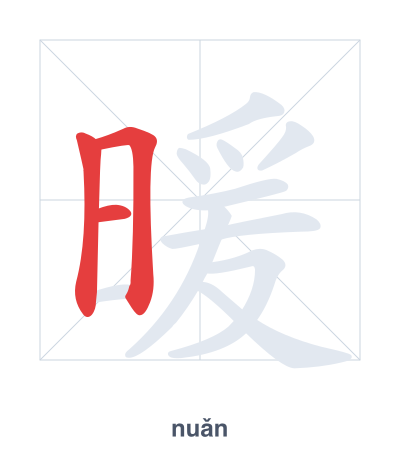
Open Hanzi Writer to see the animated stroke order and practice writing 暖 with real-time feedback.
The character 暖 (nuǎn) is written with 13 strokes. Follow the standard Chinese stroke order: top to bottom, left to right, outside before inside. The radical 日 is one of its key components.
Practice the correct stroke order with the Hanzi Writer app to see animated stroke-by-stroke guidance with real-time feedback.
暖 means warm.
As an HSK Level 3 character, 暖 is an intermediate-level character.
The character 暖 combines the sun radical (日), representing heat, with the phonetic component 爰 (yuán). Originally, 爰 depicted a hand pulling a rope, but here it gives the sound. Together, they convey the idea of warmth from the sun.
💡 Memory Tip: Picture the sun (日) shining on a friendly hand (爰) reaching out to feel its warmth.
这里的阳光很温暖。
zhè lǐ de yáng guāng hěn wēn nuǎn
The sunshine here is very warm.
今天天气很暖和。
jīn tiān tiān qì hěn nuǎn huo
The weather is very warm today.
房间里有暖气。
fáng jiān lǐ yǒu nuǎn qì
There is heating in the room.
Open Hanzi Writer to see the animated stroke order and practice writing 暖 with real-time feedback.
✨ Animated stroke order · Handwriting recognition · HSK-graded practice · Free to use
暖 combines the radical 日 (sun) on the left with the phonetic component 爰 (yuán). The sun 日 suggests warmth and heat, while 爰 provides the sound, so together they convey the idea of warm temperature.