晡 (bū) means "Late afternoon (3-5 PM)" in Chinese. It has 11 strokes with the radical 日.
Rated 4.2/5 in difficulty (advanced).
Appears in 3+ common words including 晡时 (bū shí), 晡后 (bū hòu), 申晡 (shēn bū).
Due to its 11 strokes, Hanzi Writer's error detection shows 晡 requires focused practice — most learners need 10+ attempts for consistent accuracy.
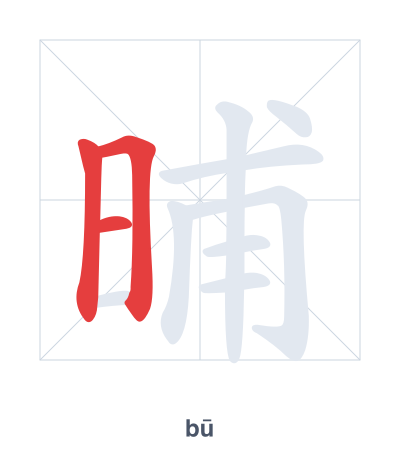
Open Hanzi Writer to see the animated stroke order and practice writing 晡 with real-time feedback.
The character 晡 (bū) is written with 11 strokes. Follow the standard Chinese stroke order: top to bottom, left to right, outside before inside. The radical 日 is one of its key components.
Practice the correct stroke order with the Hanzi Writer app to see animated stroke-by-stroke guidance with real-time feedback.
晡 means Late afternoon (3-5 PM).
The character 晡 is a phono-semantic compound: the sun radical 日 indicates the time of day, while 甫 provides the phonetic cue (though 甫 is pronounced fǔ, the series shifted to bū in this context). Together, they denote the period from 3 to 5 PM when the sun begins its descent.
💡 Memory Tip: At 3-5 PM, the sun (日) casts a long shadow of a man with a cane (甫 looks like 甫), signaling the late afternoon 'bū' hour.
现在是晡时。
xiàn zài shì bū shí
It is now the Bu period (3 p.m. to 5 p.m.).
晡后天气转凉。
bū hòu tiān qì zhuǎn liáng
The weather turns cool after late afternoon.
申晡时分太阳下山。
shēn bū shí fēn tài yáng xià shān
The sun sets in the late afternoon.
Open Hanzi Writer to see the animated stroke order and practice writing 晡 with real-time feedback.
✨ Animated stroke order · Handwriting recognition · HSK-graded practice · Free to use
The character 晡 combines the radical 日 (sun, day) on the left and the phonetic component 甫 (fǔ) on the right. 日 indicates that the word relates to time or the sun, and 甫 provides the pronunciation bū. Together they refer to the late afternoon period when the sun begins to descend.