叔 (shū) means "uncle (father's younger brother)" in Chinese. It has 8 strokes with the radical 又, and is HSK Level 4.
Rated 3.4/5 in difficulty (challenging).
Harder than 27% of HSK Level 4 characters.
Appears in 3+ common words including 叔叔 (shū shū), 大叔 (dà shū), 叔父 (shū fù).
Due to its 8 strokes, Hanzi Writer's error detection shows 叔 requires focused practice — most learners need 10+ attempts for consistent accuracy.
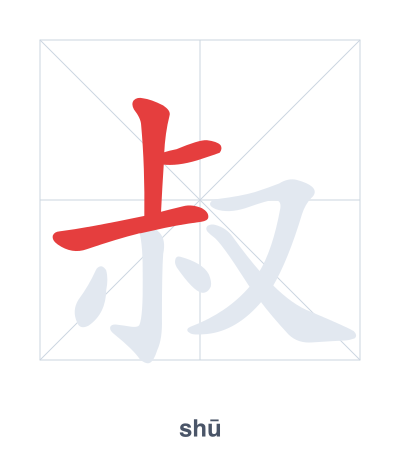
Open Hanzi Writer to see the animated stroke order and practice writing 叔 with real-time feedback.
The character 叔 (shū) is written with 8 strokes. Follow the standard Chinese stroke order: top to bottom, left to right, outside before inside. The radical 又 is one of its key components.
Practice the correct stroke order with the Hanzi Writer app to see animated stroke-by-stroke guidance with real-time feedback.
叔 means uncle (father's younger brother).
As an HSK Level 4 character, 叔 is an intermediate-level character.
Originally picturing a hand (又) picking beans (尗), the character '叔' later took on the meaning of 'uncle' (father's younger brother) through phonetic borrowing, with the hand component retaining the sense of action.
💡 Memory Tip: Imagine your uncle using his hand (又) to pick a tiny (小) bean off the ground — a silly sight that sticks in memory.
叔叔好!
shū shū hǎo
Hello, Uncle!
那位大叔很热情。
nà wèi dà shū hěn rè qíng
That uncle is very warm and friendly.
他是我的叔父。
tā shì wǒ de shū fù
He is my uncle.
Open Hanzi Writer to see the animated stroke order and practice writing 叔 with real-time feedback.
✨ Animated stroke order · Handwriting recognition · HSK-graded practice · Free to use
The character 叔 is composed of the radical 又 (hand) on the left and 尗 (shū, a phonetic and meaning component meaning "younger" or "small") on the right. The hand radical suggests action or relation, while 尗 hints at the meaning of "younger male relative," together forming "uncle (father's younger brother)."