罹 (lí) means "To suffer from; to meet with misfortune" in Chinese. It has 16 strokes with the radical 罒.
Rated 4.2/5 in difficulty (advanced).
Appears in 3+ common words including 罹患 (lí huàn), 罹难 (lí nàn), 罹病 (lí bìng).
Due to its 16 strokes, Hanzi Writer's error detection shows 罹 requires focused practice — most learners need 10+ attempts for consistent accuracy.
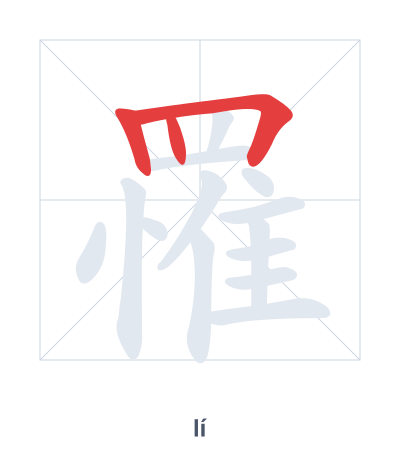
Open Hanzi Writer to see the animated stroke order and practice writing 罹 with real-time feedback.
The character 罹 (lí) is written with 16 strokes. Follow the standard Chinese stroke order: top to bottom, left to right, outside before inside. The radical 罒 is one of its key components.
Practice the correct stroke order with the Hanzi Writer app to see animated stroke-by-stroke guidance with real-time feedback.
罹 means To suffer from; to meet with misfortune.
| Character | 罹 |
| Pinyin | lí (li) |
| Meaning | To suffer from; to meet with misfortune |
| Strokes | 16 |
| Radical | 罒 |
| Difficulty | 4.2/5 |
The character 罹 combines a net (罒) with 維 (wei, to tie), picturing a bird caught in a net and bound with threads—a vivid metaphor for falling into misfortune or suffering. Originally it referred to a bird-trap, later extended to the idea of being ensnared by calamity.
💡 Memory Tip: Picture a net (罒) dropping over a bird (隹) wrapped in silk threads (糸), trapping it in a state of misery and woe.
他不幸罹患了重病。
tā bù xìng lí huàn le zhòng bìng
He unfortunately suffered from a serious illness.
许多人在事故中罹难。
xǔ duō rén zài shì gù zhōng lí nàn
Many people perished in the accident.
他因罹病而休学。
tā yīn lí bìng ér xiū xué
He took a leave of absence from school due to illness.
Open Hanzi Writer to see the animated stroke order and practice writing 罹 with real-time feedback.
✨ Animated stroke order · Handwriting recognition · HSK-graded practice · Free to use
罹 is made of the radical 罒 (a net) on top and the phonetic component 惟 (wéi) below. The net radical suggests being caught or trapped, which connects to the meaning of suffering misfortune. The bottom part 惟 primarily provides pronunciation (lí) but also adds a sense of thought or worry, reinforcing the idea of encountering trouble.