Hanzi Writer

How to Write 困 (kùn) — Meaning “Sleepy / Trapped”

kùn HSK Level 3 7 strokes Radical: 囗

困 (kùn) means "Sleepy / Trapped" in Chinese. It has 7 strokes with the radical 囗, and is HSK Level 3.

Rated 3.5/5 in difficulty (challenging).

Harder than 38% of HSK Level 3 characters.

Appears in 3+ common words including 困难 (kùn nán), 困了 (kùn le), 困境 (kùn jìng).

Due to its 7 strokes, Hanzi Writer's error detection shows 困 requires focused practice — most learners need 10+ attempts for consistent accuracy.
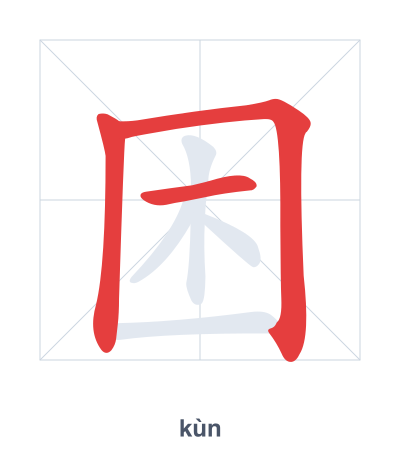
Stroke order practice for 困 - kùn

Practice Writing 困 (kùn)

Open Hanzi Writer to see the animated stroke order and practice writing 困 with real-time feedback.

The character (kùn) is written with 7 strokes. Follow the standard Chinese stroke order: top to bottom, left to right, outside before inside. The radical is one of its key components.

Practice the correct stroke order with the Hanzi Writer app to see animated stroke-by-stroke guidance with real-time feedback.

means Sleepy / Trapped.

As an HSK Level 3 character, is an intermediate-level character.

Character
Pinyinkùn (kun)
MeaningSleepy / Trapped
Strokes7
Radical
HSK Level3
Difficulty3.5/5

困 combines the radical 囗 (an enclosure) with 木 (tree), literally depicting a tree trapped within a bounded space. This imagery conveys the idea of being confined or stuck, which extended to the feeling of being trapped by sleepiness. The character's earliest forms in oracle bone script show a tree inside an enclosure, emphasizing the sense of entrapment.

💡 Memory Tip: Imagine a tree (木) stuck inside a big square box (囗), feeling so trapped that it gets sleepy and starts to yawn.

kùn nán
Difficulty / Hard
kùn le
Sleepy
kùn jìng
Dilemma / Predicament

这个问题很困难。

zhè ge wèn tí hěn kùn nán

This problem is very difficult.

我困了,想睡觉。

wǒ kùn le xiǎng shuì jiào

I'm sleepy and want to sleep.

他走出了困境。

tā zǒu chū le kùn jìng

He got out of the predicament.

Character Pinyin Strokes Radical
(current) kùn 7
qiú 5
5
jiǎn 6
Stroke order practice for 困 - kùn

Practice Writing 困 (kùn)

Open Hanzi Writer to see the animated stroke order and practice writing 困 with real-time feedback.

✨ Animated stroke order · Handwriting recognition · HSK-graded practice · Free to use

Frequently Asked Questions about 困

困 is formed by an outer square radical 囗, meaning 'enclosure' or 'boundary', and an inner component 木, meaning 'tree' or 'wood'. This structure suggests a tree trapped inside a box, which visually represents the ideas of being trapped or confined, and also connects to the feeling of being sleepy as if confined to rest.

More HSK Level 3 Characters

Characters with Radical 囗

Other 7-Stroke Characters