漠 (mò) means "indifferent / desert" in Chinese. It has 13 strokes with the radical 氵, and is HSK Level 5.
Rated 4.2/5 in difficulty (advanced).
Harder than 79% of HSK Level 5 characters.
Appears in 3+ common words including 沙漠 (shā mò), 冷漠 (lěng mò), 漠视 (mò shì).
Due to its 13 strokes, Hanzi Writer's error detection shows 漠 requires focused practice — most learners need 10+ attempts for consistent accuracy.
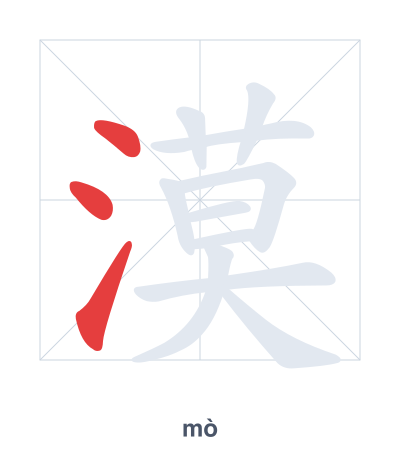
Open Hanzi Writer to see the animated stroke order and practice writing 漠 with real-time feedback.
The character 漠 (mò) is written with 13 strokes. Follow the standard Chinese stroke order: top to bottom, left to right, outside before inside. The radical 氵 is one of its key components.
Practice the correct stroke order with the Hanzi Writer app to see animated stroke-by-stroke guidance with real-time feedback.
漠 means indifferent / desert.
As an HSK Level 5 character, 漠 is an intermediate-level character.
漠 combines the water radical 氵 with 莫, which means 'none' or 'not.' The original meaning is a vast expanse of dry land lacking water—a desert. The visual structure thus depicts a place where there is no water (莫) in the landscape (氵).
💡 Memory Tip: Imagine a desert with no water (氵), where everything is covered by a vast blanket of sand (莫 like 'none'), making all life indifferent to the harsh dryness.
沙漠里有很多沙子。
shā mò lǐ yǒu hěn duō shā zi
There is a lot of sand in the desert.
他的态度很冷漠。
tā de tài dù hěn lěng mò
His attitude is very cold and indifferent.
不要漠视交通规则。
bú yào mò shì jiāo tōng guī zé
Don't ignore traffic rules.
Open Hanzi Writer to see the animated stroke order and practice writing 漠 with real-time feedback.
✨ Animated stroke order · Handwriting recognition · HSK-graded practice · Free to use
The left side is the water radical 氵, which hints at water or liquid. The right side is 莫 (mò), which means "nothing" or "do not." Together, 漠 uses water and the idea of nothingness to suggest a dry, waterless place like a desert, or a cold, indifferent attitude.