蔑 (miè) means "To despise / To slight" in Chinese. It has 14 strokes with the radical 艹, and is HSK Level 7.
Rated 4.2/5 in difficulty (advanced).
Harder than 87% of HSK Level 7 characters.
Appears in 3+ common words including 轻蔑 (qīng miè), 蔑视 (miè shì), 污蔑 (wū miè).
Due to its 14 strokes, Hanzi Writer's error detection shows 蔑 requires focused practice — most learners need 10+ attempts for consistent accuracy.
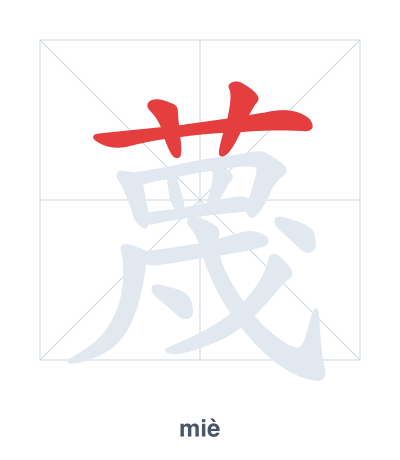
Open Hanzi Writer to see the animated stroke order and practice writing 蔑 with real-time feedback.
The character 蔑 (miè) is written with 14 strokes. Follow the standard Chinese stroke order: top to bottom, left to right, outside before inside. The radical 艹 is one of its key components.
Practice the correct stroke order with the Hanzi Writer app to see animated stroke-by-stroke guidance with real-time feedback.
蔑 means To despise / To slight.
As an HSK Level 7 character, 蔑 is an intermediate-level character.
蔑 combines 'grass' (艹) with 'guard' (戍) and an 'eye' (目) to depict a guard stepping on grass, symbolizing trampling something underfoot as a gesture of contempt or disregard.
💡 Memory Tip: Picture a guard (戍) with a piercing eye (目) crushing grass (艹) under his boot to show he despises it.
他的眼神很轻蔑。
tā de yǎn shén hěn qīng miè
His gaze is very scornful.
我们不能蔑视他人。
wǒ men bù néng miè shì tā rén
We cannot despise others.
这是对他的污蔑。
zhè shì duì tā de wū miè
This is a slander against him.
Open Hanzi Writer to see the animated stroke order and practice writing 蔑 with real-time feedback.
✨ Animated stroke order · Handwriting recognition · HSK-graded practice · Free to use
The character 蔑 is composed of three parts: the radical 艹 (grass) on top, a net shape 罒 in the middle, and the component 戍 (to guard) at the bottom. While these parts do not directly create the meaning of "to despise," the grass and net together suggest covering or hiding, which can relate to the idea of ignoring or slighting someone.