萠 (pān) means "sprout (variant of 萌)" in Chinese. It has 12 strokes with the radical 艹.
Rated 4.2/5 in difficulty (advanced).
Appears in 3+ common words including 萠芽 (pān yá), 萠发 (pān fā), 萠生 (pān shēng).
Due to its 12 strokes, Hanzi Writer's error detection shows 萠 requires focused practice — most learners need 10+ attempts for consistent accuracy.
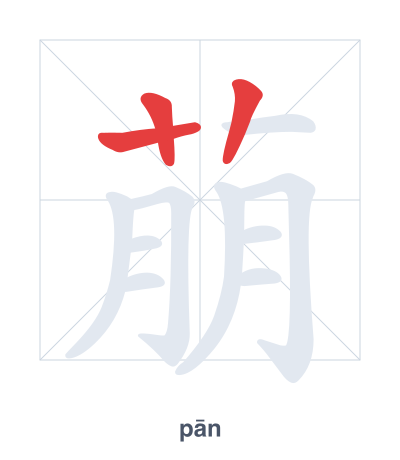
Open Hanzi Writer to see the animated stroke order and practice writing 萠 with real-time feedback.
The character 萠 (pān) is written with 12 strokes. Follow the standard Chinese stroke order: top to bottom, left to right, outside before inside. The radical 艹 is one of its key components.
Practice the correct stroke order with the Hanzi Writer app to see animated stroke-by-stroke guidance with real-time feedback.
萠 means sprout (variant of 萌).
This character is a variant of 萌 (méng), combining the grass radical 艹 with 朋 (péng) as a phonetic component. The grass on top represents vegetation, while the bottom part originally symbolized the budding energy of new growth, similar to sprouts emerging from the soil.
💡 Memory Tip: Picture two moons (朋) rising over the grass (艹), their light coaxing tiny green sprouts to pop up from the earth.
春天草木萠芽。
chūn tiān cǎo mù pān yá
Plants and trees sprout in spring.
希望在心中萠发。
xī wàng zài xīn zhōng pān fā
Hope is sprouting in the heart.
新的想法萠生了。
xīn de xiǎng fǎ pān shēng le
A new idea has emerged.
Open Hanzi Writer to see the animated stroke order and practice writing 萠 with real-time feedback.
✨ Animated stroke order · Handwriting recognition · HSK-graded practice · Free to use
萠 combines the radical 艹 (grass) on top with 朋 (friend) below. The grass radical shows the character is related to plants, while 朋 suggests sprouts growing together like friends. This structure creates a variant of 萌, both meaning "sprout."