菐 (pú) means "servant (archaic)" in Chinese. It has 12 strokes with the radical 艹.
Rated 4.2/5 in difficulty (advanced).
Appears in 3+ common words including 菐菐 (pú pú), 菐从 (pú cóng), 菐人 (pú rén).
Due to its 12 strokes, Hanzi Writer's error detection shows 菐 requires focused practice — most learners need 10+ attempts for consistent accuracy.
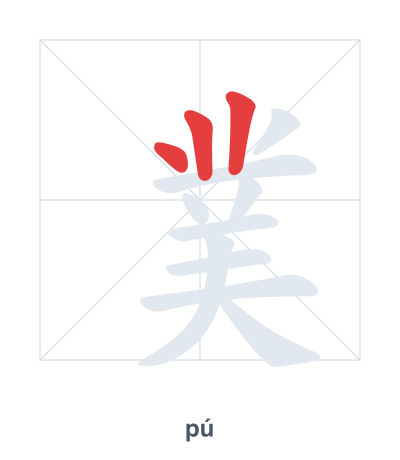
Open Hanzi Writer to see the animated stroke order and practice writing 菐 with real-time feedback.
The character 菐 (pú) is written with 12 strokes. Follow the standard Chinese stroke order: top to bottom, left to right, outside before inside. The radical 艹 is one of its key components.
Practice the correct stroke order with the Hanzi Writer app to see animated stroke-by-stroke guidance with real-time feedback.
菐 means servant (archaic).
菐 combines 艹 (grass) and a component resembling 業 (work), suggesting a servant performing humble agricultural labor. The grass may also represent a simple head covering worn by laborers.
💡 Memory Tip: Picture a servant (菐) wearing a grass hat (艹) and slogging through endless field work (bottom shape like 業) under a hot sun.
路上有很多菐菐的尘土。
lù shàng yǒu hěn duō pú pú de chén tǔ
There is a lot of thick dust on the road.
他带着几个菐从。
tā dài zhe jǐ gè pú cóng
He brought several attendants with him.
菐人正在打扫房间。
pú rén zhèng zài dǎ sǎo fáng jiān
The servant is cleaning the room.
Open Hanzi Writer to see the animated stroke order and practice writing 菐 with real-time feedback.
✨ Animated stroke order · Handwriting recognition · HSK-graded practice · Free to use
The character 菐 has the grass radical 艹 on top, and the lower part is also 菐, which acts as a phonetic component. The grass radical hints at outdoor labor, like working in fields, which connects to the archaic meaning of 'servant' who toils.