吗 (ma/mǎ) means "question particle" in Chinese. It has 6 strokes with the radical 口, and is HSK Level 1.
Rated 2.7/5 in difficulty (moderate).
Harder than 40% of HSK Level 1 characters.
Appears in 4+ common words including 好吗 (hǎo ma), 是吗 (shì ma), 去吗 (qù ma).
Hanzi Writer's stroke validation shows learners typically need 5-8 attempts to write 吗 with correct proportion and order.
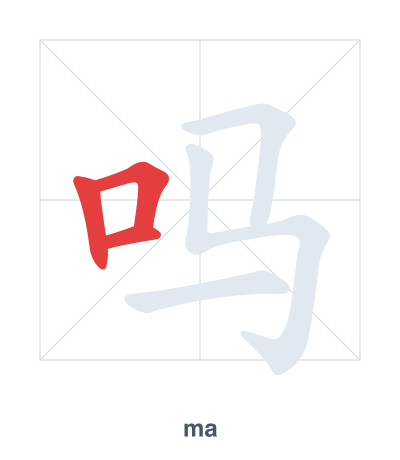
Open Hanzi Writer to see the animated stroke order and practice writing 吗 with real-time feedback.
The character 吗 (ma/mǎ) is written with 6 strokes. Follow the standard Chinese stroke order: top to bottom, left to right, outside before inside. The radical 口 is one of its key components.
Practice the correct stroke order with the Hanzi Writer app to see animated stroke-by-stroke guidance with real-time feedback.
吗 means question particle.
This is a polyphonic character with readings: ma, mǎ.
As an HSK Level 1 character, 吗 is among the first characters beginners learn.
吗 is a phono-semantic compound: the left radical 口 (mouth) represents speech or questioning, and the right component 马 (horse) provides the approximate pronunciation. This character is used as a question particle in Chinese, turning a statement into a yes/no question.
💡 Memory Tip: Imagine a horse (马) opening its mouth (口) to ask a puzzled 'Neigh?' — turning any statement into a question.
我们去公园好吗?
wǒ men qù gōng yuán hǎo ma
Shall we go to the park?
是吗?我不知道。
shì ma wǒ bù zhī dào
Really? I didn't know.
你明天去吗?
nǐ míng tiān qù ma
Are you going tomorrow?
吗啡是一种强效止痛药。
mǎ fēi shì yī zhǒng qiáng xiào zhǐ tòng yào
Morphine is a powerful painkiller.
Open Hanzi Writer to see the animated stroke order and practice writing 吗 with real-time feedback.
✨ Animated stroke order · Handwriting recognition · HSK-graded practice · Free to use
吗 is made of 口 (mouth radical) on the left and 马 (horse) on the right. The mouth radical suggests speech or sound, while 马 gives the pronunciation (ma). Together, 吗 is a question particle used at the end of sentences to ask yes/no questions.