邻 (lín) means "neighbor / adjacent" in Chinese. It has 7 strokes with the radical 阝, and is HSK Level 5.
Rated 3.2/5 in difficulty (challenging).
Harder than 17% of HSK Level 5 characters.
Appears in 3+ common words including 邻居 (lín jū), 邻近 (lín jìn), 邻里 (lín lǐ).
Due to its 7 strokes, Hanzi Writer's error detection shows 邻 requires focused practice — most learners need 10+ attempts for consistent accuracy.
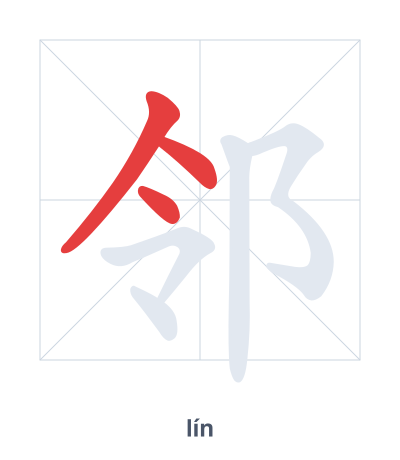
Open Hanzi Writer to see the animated stroke order and practice writing 邻 with real-time feedback.
The character 邻 (lín) is written with 7 strokes. Follow the standard Chinese stroke order: top to bottom, left to right, outside before inside. The radical 阝 is one of its key components.
Practice the correct stroke order with the Hanzi Writer app to see animated stroke-by-stroke guidance with real-time feedback.
邻 means neighbor / adjacent.
As an HSK Level 5 character, 邻 is an intermediate-level character.
The character 邻 combines the 'place' radical 阝 (a variant of 阜, meaning mound or city) with the phonetic component 令 (lìng, 'order'). It originally referred to a unit of five neighboring households in ancient China, highlighting the idea of adjacent communities. The left side suggests a location, while the right side provides pronunciation.
💡 Memory Tip: Picture a neighbor living on a hill (阝) who constantly orders (令) you around from next door.
我的邻居很友好。
wǒ de lín jū hěn yǒu hǎo
My neighbor is very friendly.
学校邻近公园。
xué xiào lín jìn gōng yuán
The school is near the park.
邻里关系很重要。
lín lǐ guān xì hěn zhòng yào
Neighborhood relations are very important.
Open Hanzi Writer to see the animated stroke order and practice writing 邻 with real-time feedback.
✨ Animated stroke order · Handwriting recognition · HSK-graded practice · Free to use
邻 is made of the left radical 阝, which means "place" or "hill," and the right part 令 (lìng, "order/command"). Together, 阝 indicates a location, and 令 gives a phonetic clue while subtly suggesting that a neighbor is someone who lives in an ordered community nearby.