痢 (lì) means "dysentery" in Chinese. It has 12 strokes with the radical 疒.
Rated 4.2/5 in difficulty (advanced).
Appears in 3+ common words including 痢疾 (lì jí), 拉痢疾 (lā lì jí), 痢疾药 (lì jí yào).
Due to its 12 strokes, Hanzi Writer's error detection shows 痢 requires focused practice — most learners need 10+ attempts for consistent accuracy.
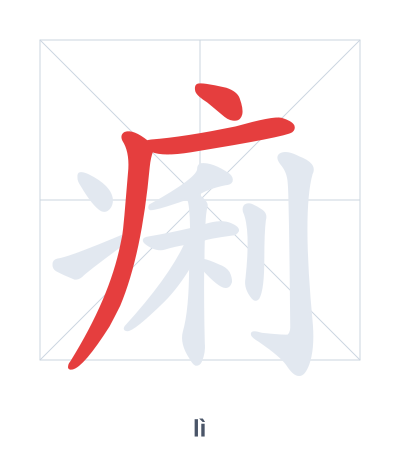
Open Hanzi Writer to see the animated stroke order and practice writing 痢 with real-time feedback.
The character 痢 (lì) is written with 12 strokes. Follow the standard Chinese stroke order: top to bottom, left to right, outside before inside. The radical 疒 is one of its key components.
Practice the correct stroke order with the Hanzi Writer app to see animated stroke-by-stroke guidance with real-time feedback.
痢 means dysentery.
痢 combines the illness radical 疒 (sickness) with 利 (sharp, profit), evoking the sharp, painful cramps characteristic of dysentery. The 利 component also provides the phonetic hint for the pronunciation lì.
💡 Memory Tip: Picture a sick person (疒) clutching their stomach from sharp (利) pains, rushing to the toilet with dysentery.
喝脏水容易得痢疾。
hē zàng shuǐ róng yì dé lì jí
Drinking dirty water can easily cause dysentery.
他这几天在拉痢疾。
tā zhè jǐ tiān zài lā lì jí
He has been suffering from dysentery these past few days.
这种痢疾药很有效。
zhè zhǒng lì jí yào hěn yǒu xiào
This dysentery medicine is very effective.
Open Hanzi Writer to see the animated stroke order and practice writing 痢 with real-time feedback.
✨ Animated stroke order · Handwriting recognition · HSK-graded practice · Free to use
The character 痢 combines the radical 疒 (sickness) on the left with the component 利 on the right. The radical indicates that the character relates to illness or disease, while 利 provides the pronunciation (lì) and may hint at the sharp, painful nature of dysentery.