唠 (láo/lào) means "To chatter / To nag" in Chinese. It has 10 strokes with the radical 口, and is HSK Level 7.
Rated 4.2/5 in difficulty (advanced).
Harder than 48% of HSK Level 7 characters.
Appears in 3+ common words including 唠叨 (láo dāo), 唠嗑 (lào kē), 闲唠 (xián lào).
Due to its 10 strokes, Hanzi Writer's error detection shows 唠 requires focused practice — most learners need 10+ attempts for consistent accuracy.
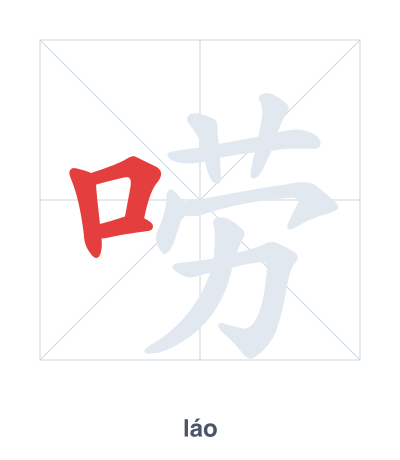
Open Hanzi Writer to see the animated stroke order and practice writing 唠 with real-time feedback.
The character 唠 (láo/lào) is written with 10 strokes. Follow the standard Chinese stroke order: top to bottom, left to right, outside before inside. The radical 口 is one of its key components.
Practice the correct stroke order with the Hanzi Writer app to see animated stroke-by-stroke guidance with real-time feedback.
唠 means To chatter / To nag.
This is a polyphonic character with readings: láo, lào.
As an HSK Level 7 character, 唠 is an intermediate-level character.
唠 is a compound character with the radical 口 (mouth) and the phonetic component 劳 (láo, meaning 'labor' or 'toil'). The mouth (口) indicates speaking, while 劳 suggests exhausting effort — together they depict the idea of 'laboring with one's mouth,' i.e., chattering or nagging endlessly.
💡 Memory Tip: Picture a worker (劳) with a huge mouth (口) who won't stop talking, laboring everyone's ears with constant nagging.
妈妈很喜欢唠叨。
mā mā hěn xǐ huān láo dāo
Mom likes to nag.
我们在家里唠嗑。
wǒ men zài jiā lǐ lào kē
We are chatting at home.
他们在路边闲唠。
tā men zài lù biān xián lào
They are chatting by the roadside.
Open Hanzi Writer to see the animated stroke order and practice writing 唠 with real-time feedback.
✨ Animated stroke order · Handwriting recognition · HSK-graded practice · Free to use
唠 is made of the radical 口 (mouth) on the left and 劳 (labor/toil) on the right. The mouth indicates speaking, and 劳 suggests doing something with effort or repetition, so together they mean to chatter or nag tirelessly.