嗑 (kē) means "To crack between teeth; to chat" in Chinese. It has 13 strokes with the radical 口.
Rated 4.2/5 in difficulty (advanced).
Appears in 3+ common words including 嗑瓜子 (kē guā zi), 闲嗑 (xián kē), 嗑碰 (kē pèng).
Due to its 13 strokes, Hanzi Writer's error detection shows 嗑 requires focused practice — most learners need 10+ attempts for consistent accuracy.
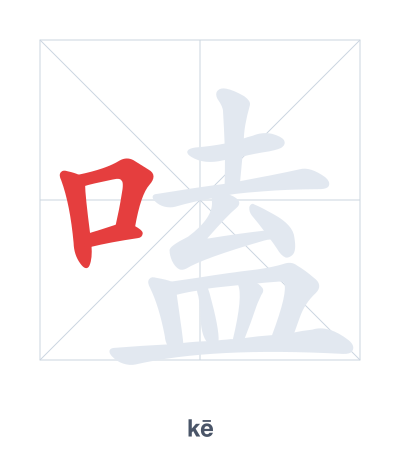
Open Hanzi Writer to see the animated stroke order and practice writing 嗑 with real-time feedback.
The character 嗑 (kē) is written with 13 strokes. Follow the standard Chinese stroke order: top to bottom, left to right, outside before inside. The radical 口 is one of its key components.
Practice the correct stroke order with the Hanzi Writer app to see animated stroke-by-stroke guidance with real-time feedback.
嗑 means To crack between teeth; to chat.
嗑 combines 口 (mouth) with 盍 (lid/cover), where 盍 also provides pronunciation. The mouth (口) suggests an action involving the mouth, and the lid (盍) hints at the cracking sound of breaking a shell or seed between teeth. This relates both to cracking nuts/seeds and to the constant mouth movement in chatting.
💡 Memory Tip: Picture someone putting a sunflower seed (like a tiny lid, 盍) into their mouth (口) and cracking it open with a satisfying '嗑' sound.
我们坐着嗑瓜子。
wǒ men zuò zhe kē guā zi
We are sitting and cracking melon seeds.
邻居们在门口闲嗑。
lín jū men zài mén kǒu xián kē
The neighbors are chatting at the door.
牙齿不小心嗑了一下。
yá chǐ bù xiǎo xīn kē le yī xià
I accidentally bumped my tooth.
Open Hanzi Writer to see the animated stroke order and practice writing 嗑 with real-time feedback.
✨ Animated stroke order · Handwriting recognition · HSK-graded practice · Free to use
嗑 is made of the left radical 口 (mouth) and the right component 盍 (lid or cover). The mouth radical directly connects to actions done with the mouth, like cracking seeds or chatting. The right side 盍 suggests a covering or closing motion, which fits the idea of closing teeth to crack something.