筷 (kuài) means "chopstick" in Chinese. It has 13 strokes with the radical 竹, and is HSK Level 2.
Rated 3.7/5 in difficulty (challenging).
Harder than 90% of HSK Level 2 characters.
Appears in 3+ common words including 筷子 (kuài zi), 竹筷 (zhú kuài), 拿筷子 (ná kuài zi).
Due to its 13 strokes, Hanzi Writer's error detection shows 筷 requires focused practice — most learners need 10+ attempts for consistent accuracy.
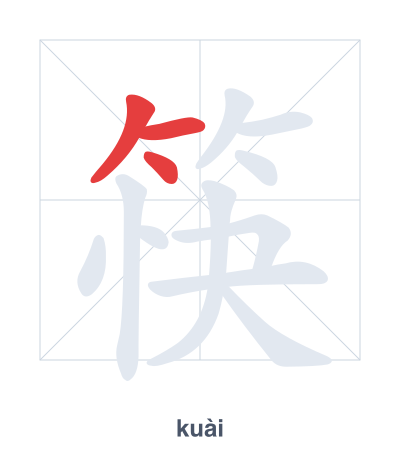
Open Hanzi Writer to see the animated stroke order and practice writing 筷 with real-time feedback.
The character 筷 (kuài) is written with 13 strokes. Follow the standard Chinese stroke order: top to bottom, left to right, outside before inside. The radical 竹 is one of its key components.
Practice the correct stroke order with the Hanzi Writer app to see animated stroke-by-stroke guidance with real-time feedback.
筷 means chopstick.
As an HSK Level 2 character, 筷 is among the first characters beginners learn.
筷 combines the bamboo radical 竹 (竹) with the phonetic component 快 (kuài, meaning 'fast'). Since chopsticks are traditionally made of bamboo and allow quick eating, the character literally suggests 'bamboo speed.'
💡 Memory Tip: Picture two bamboo sticks racing (快) to pick up food—they are chopsticks moving at lightning speed.
我会用筷子吃饭。
wǒ huì yòng kuài zi chī fàn
I can eat with chopsticks.
这双竹筷很轻。
zhè shuāng zhú kuài hěn qīng
This pair of bamboo chopsticks is very light.
请帮我拿筷子。
qǐng bāng wǒ ná kuài zi
Please get me some chopsticks.
Open Hanzi Writer to see the animated stroke order and practice writing 筷 with real-time feedback.
✨ Animated stroke order · Handwriting recognition · HSK-graded practice · Free to use
筷 is made of two parts: the radical 竹 (bamboo) on top/left and 快 (kuài, fast) on the bottom/right. The bamboo radical shows that chopsticks are traditionally made of bamboo, while 快 provides the pronunciation and hints at quick eating. Together, they form the character for "chopstick."