笞 (chī) means "to flog with bamboo" in Chinese. It has 11 strokes with the radical 竹.
Rated 4.2/5 in difficulty (advanced).
Appears in 3+ common words including 鞭笞 (biān chī), 笞刑 (chī xíng), 笞打 (chī dǎ).
Due to its 11 strokes, Hanzi Writer's error detection shows 笞 requires focused practice — most learners need 10+ attempts for consistent accuracy.
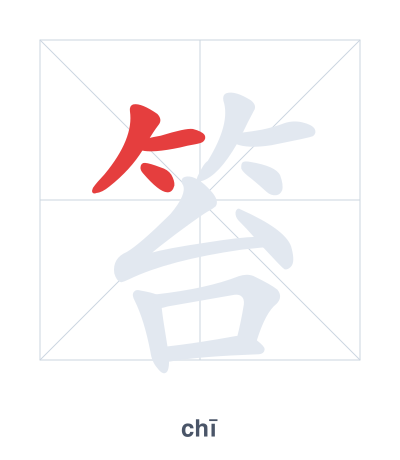
Open Hanzi Writer to see the animated stroke order and practice writing 笞 with real-time feedback.
The character 笞 (chī) is written with 11 strokes. Follow the standard Chinese stroke order: top to bottom, left to right, outside before inside. The radical 竹 is one of its key components.
Practice the correct stroke order with the Hanzi Writer app to see animated stroke-by-stroke guidance with real-time feedback.
笞 means to flog with bamboo.
笞 is a compound character: the radical 竹 (bamboo) indicates the material of the whip, while 台 (tái) provides the phonetic element. Together, they depict a bamboo implement used for corporal punishment, specifically flogging.
💡 Memory Tip: Picture a bamboo cane (竹) resting on a raised platform (台) used for flogging disobedient students.
他受到了鞭笞。
tā shòu dào le biān chī
He was whipped.
古代有笞刑。
gǔ dài yǒu chī xíng
There was the punishment of flogging in ancient times.
他被笞打了一顿。
tā bèi chī dǎ le yī dùn
He was given a flogging.
Open Hanzi Writer to see the animated stroke order and practice writing 笞 with real-time feedback.
✨ Animated stroke order · Handwriting recognition · HSK-graded practice · Free to use
The character 笞 is composed of the radical 竹 (bamboo) on top and the phonetic component 台 (tái) below. The bamboo radical indicates that the instrument used for flogging was made of bamboo. The whole character means "to flog with a bamboo stick."