笙 (shēng) means "sheng (a reed pipe wind instrument)" in Chinese. It has 11 strokes with the radical 竹.
Rated 4.2/5 in difficulty (advanced).
Appears in 3+ common words including 笙箫 (shēng xiāo), 笙歌 (shēng gē), 芦笙 (lú shēng).
Due to its 11 strokes, Hanzi Writer's error detection shows 笙 requires focused practice — most learners need 10+ attempts for consistent accuracy.
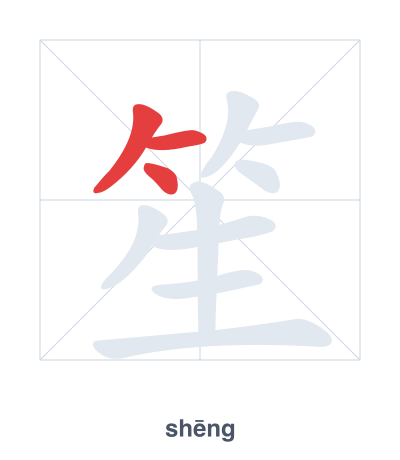
Open Hanzi Writer to see the animated stroke order and practice writing 笙 with real-time feedback.
The character 笙 (shēng) is written with 11 strokes. Follow the standard Chinese stroke order: top to bottom, left to right, outside before inside. The radical 竹 is one of its key components.
Practice the correct stroke order with the Hanzi Writer app to see animated stroke-by-stroke guidance with real-time feedback.
笙 means sheng (a reed pipe wind instrument).
笙 combines the bamboo radical (竹) with 生 (shēng, 'to produce' or 'life'), indicating a wind instrument made from bamboo that produces sound. The 生 component also provides a phonetic clue to the pronunciation.
💡 Memory Tip: Picture bamboo pipes (竹) sprouting like living plants (生) to form a reed instrument that breathes out music.
他在吹笙箫。
tā zài chuī shēng xiāo
He is playing the sheng and xiao.
这里到处是笙歌。
zhè lǐ dào chù shì shēng gē
The sound of music and singing is everywhere here.
他会吹芦笙。
tā huì chuī lú shēng
He can play the lusheng (a reed pipe).
Open Hanzi Writer to see the animated stroke order and practice writing 笙 with real-time feedback.
✨ Animated stroke order · Handwriting recognition · HSK-graded practice · Free to use
The character 笙 consists of the radical 竹 (bamboo) on top, indicating that the instrument is made from bamboo, and the phonetic component 生 (shēng, meaning "life" or "to grow") below. The bamboo radical directly reflects that the sheng is a reed instrument traditionally crafted from bamboo tubes.