窟 (kū) means "cave / hole" in Chinese. It has 13 strokes with the radical 穴, and is HSK Level 7.
Rated 4.2/5 in difficulty (advanced).
Harder than 78% of HSK Level 7 characters.
Appears in 3+ common words including 洞窟 (dòng kū), 窟窿 (kū lóng), 石窟 (shí kū).
Due to its 13 strokes, Hanzi Writer's error detection shows 窟 requires focused practice — most learners need 10+ attempts for consistent accuracy.
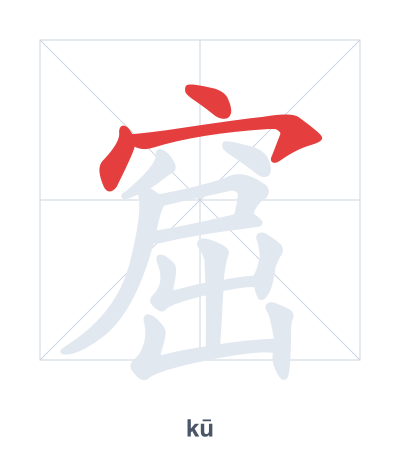
Open Hanzi Writer to see the animated stroke order and practice writing 窟 with real-time feedback.
The character 窟 (kū) is written with 13 strokes. Follow the standard Chinese stroke order: top to bottom, left to right, outside before inside. The radical 穴 is one of its key components.
Practice the correct stroke order with the Hanzi Writer app to see animated stroke-by-stroke guidance with real-time feedback.
窟 means cave / hole.
As an HSK Level 7 character, 窟 is an intermediate-level character.
窟 combines the radical 穴 (cave) with 屈 (bend), suggesting a bent or recessed hollow space underground. The upper part 穴 shows a cave entrance, while 屈 adds the idea of a cramped, winding interior.
💡 Memory Tip: Picture a person bending down (屈) to crawl into a cave (穴) through a narrow hole.
这里的洞窟很大。
zhè lǐ de dòng kū hěn dà
The caves here are very large.
衣服破了一个窟窿。
yī fú pò le yí gè kū lóng
There is a hole in the clothes.
我们去参观石窟。
wǒ men qù cān guān shí kū
We are going to visit the grottoes.
Open Hanzi Writer to see the animated stroke order and practice writing 窟 with real-time feedback.
✨ Animated stroke order · Handwriting recognition · HSK-graded practice · Free to use
窟 consists of the radical 穴 (cave) on top and the component 屈 (to bend) below. The radical gives the meaning of a cave or hole, while 屈 suggests a bent or low space, together forming the idea of a cavity or hollow place.