登 (dēng) means "to climb; to publish; to register; to board" in Chinese. It has 12 strokes with the radical 癶, and is HSK Level 4.
Rated 3.8/5 in difficulty (challenging).
Harder than 52% of HSK Level 4 characters.
Appears in 3+ common words including 登山 (dēng shān), 登记 (dēng jì), 登机 (dēng jī).
Due to its 12 strokes, Hanzi Writer's error detection shows 登 requires focused practice — most learners need 10+ attempts for consistent accuracy.
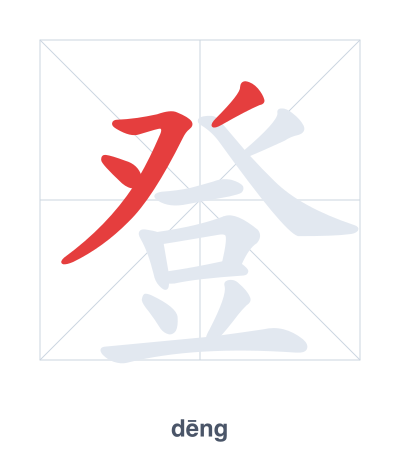
Open Hanzi Writer to see the animated stroke order and practice writing 登 with real-time feedback.
The character 登 (dēng) is written with 12 strokes. Follow the standard Chinese stroke order: top to bottom, left to right, outside before inside. The radical 癶 is one of its key components.
Practice the correct stroke order with the Hanzi Writer app to see animated stroke-by-stroke guidance with real-time feedback.
登 means to climb; to publish; to register; to board.
As an HSK Level 4 character, 登 is an intermediate-level character.
The character 登 shows two feet (癶) climbing upward on steps or a platform, with the lower part 豆 originally representing a vessel or drum used in ceremonies. This combination evokes the idea of ascending a raised structure, which led to meanings like 'to climb' and 'to mount', later extended to 'to publish' and 'to register' as in ascending to a public record.
💡 Memory Tip: Two feet (癶) step on a bean (豆) to climb up the mountain.
我们周末去登山吧。
wǒ men zhōu mò qù dēng shān ba
Let's go mountain climbing this weekend.
请在这里登记名字。
qǐng zài zhè lǐ dēng jì míng zì
Please register your name here.
乘客正在登机。
chéng kè zhèng zài dēng jī
Passengers are boarding the plane.
Open Hanzi Writer to see the animated stroke order and practice writing 登 with real-time feedback.
✨ Animated stroke order · Handwriting recognition · HSK-graded practice · Free to use
The character 登 consists of two parts: the top radical 癶, which resembles two feet stepping upward, and the bottom 豆, originally a vessel for offerings. Together, these suggest the idea of ascending or stepping onto something, linking to the meanings 'to climb' and 'to board'.