掘 (jué) means "to dig or excavate" in Chinese. It has 11 strokes with the radical 扌, and is HSK Level 7.
Rated 4.2/5 in difficulty (advanced).
Harder than 59% of HSK Level 7 characters.
Appears in 3+ common words including 挖掘 (wā jué), 发掘 (fā jué), 掘地 (jué dì).
Due to its 11 strokes, Hanzi Writer's error detection shows 掘 requires focused practice — most learners need 10+ attempts for consistent accuracy.
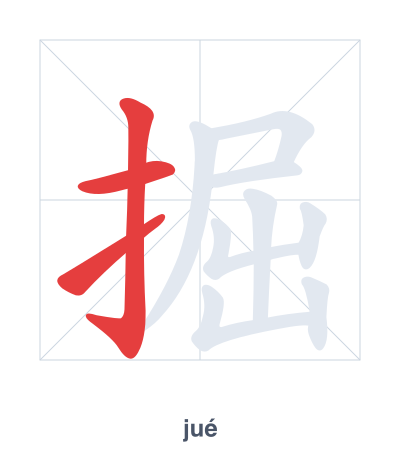
Open Hanzi Writer to see the animated stroke order and practice writing 掘 with real-time feedback.
The character 掘 (jué) is written with 11 strokes. Follow the standard Chinese stroke order: top to bottom, left to right, outside before inside. The radical 扌 is one of its key components.
Practice the correct stroke order with the Hanzi Writer app to see animated stroke-by-stroke guidance with real-time feedback.
掘 means to dig or excavate.
As an HSK Level 7 character, 掘 is an intermediate-level character.
掘 is a compound character combining the hand radical 扌 (showing action) with 屈 (qū, meaning 'to bend'), suggesting the motion of bending over to dig with one's hands. The right component provides phonetic guidance while reinforcing the physical posture of excavation.
💡 Memory Tip: Picture a hand (扌) bending (屈) down to scoop out a hole in the earth.
工人在挖掘隧道。
gōng rén zài wā jué suì dào
The worker is excavating a tunnel.
考古学家发掘了古墓。
kǎo gǔ xué jiā fā jué le gǔ mù
Archaeologists excavated the ancient tomb.
他在花园里掘地。
tā zài huā yuán lǐ jué dì
He is digging in the garden.
Open Hanzi Writer to see the animated stroke order and practice writing 掘 with real-time feedback.
✨ Animated stroke order · Handwriting recognition · HSK-graded practice · Free to use
The character 掘 is formed by the radical 扌 (hand) on the left and the component 屈 (to bend) on the right. The hand radical indicates the action of using one's hand, while 屈 suggests bending or curving, together giving the sense of bending down or using force to dig into the ground.