竭 (jié) means "To exhaust; to use up" in Chinese. It has 14 strokes with the radical 立, and is HSK Level 7.
Rated 4.2/5 in difficulty (advanced).
Harder than 78% of HSK Level 7 characters.
Appears in 3+ common words including 竭力 (jié lì), 枯竭 (kū jié), 竭诚 (jié chéng).
Due to its 14 strokes, Hanzi Writer's error detection shows 竭 requires focused practice — most learners need 10+ attempts for consistent accuracy.
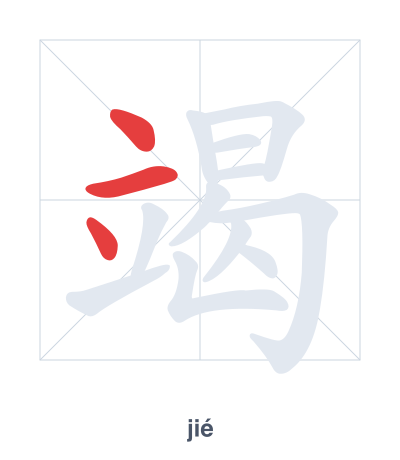
Open Hanzi Writer to see the animated stroke order and practice writing 竭 with real-time feedback.
The character 竭 (jié) is written with 14 strokes. Follow the standard Chinese stroke order: top to bottom, left to right, outside before inside. The radical 立 is one of its key components.
Practice the correct stroke order with the Hanzi Writer app to see animated stroke-by-stroke guidance with real-time feedback.
竭 means To exhaust; to use up.
As an HSK Level 7 character, 竭 is an intermediate-level character.
The character 竭 combines the radical 立 (standing) with the phonetic component 曷 (meaning 'to stop' or 'to ask'). Together, they suggest standing in place and repeatedly calling out until one's energy is completely drained, hence the meaning 'to exhaust' or 'to use up.'
💡 Memory Tip: Picture a person standing (立) under a scorching sun (曷's top part resembles 日) with an open mouth (曷's 口), gasping from exhaustion after using up all their energy.
我会竭力完成。
wǒ huì jié lì wán chéng
I will do my utmost to complete it.
水源已经枯竭。
shuǐ yuán yǐ jīng kū jié
The water source has dried up.
我们竭诚为您服务。
wǒ men jié chéng wèi nín fú wù
We serve you wholeheartedly.
Open Hanzi Writer to see the animated stroke order and practice writing 竭 with real-time feedback.
✨ Animated stroke order · Handwriting recognition · HSK-graded practice · Free to use
The character 竭 is composed of 立 (lì, 'to stand') on the left and 曷 (hé, an archaic component meaning 'why' or 'to stop') on the right. Together, they suggest a person standing and reaching a limit, implying the idea of exhausting or using up all resources.