稼 (jià) means "To sow; crops" in Chinese. It has 15 strokes with the radical 禾, and is HSK Level 7.
Rated 4.2/5 in difficulty (advanced).
Harder than 77% of HSK Level 7 characters.
Appears in 3+ common words including 庄稼 (zhuāng jià), 庄稼人 (zhuāng jià rén), 庄稼地 (zhuāng jià dì).
Due to its 15 strokes, Hanzi Writer's error detection shows 稼 requires focused practice — most learners need 10+ attempts for consistent accuracy.
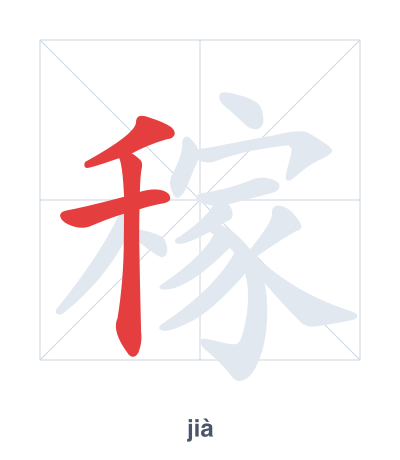
Open Hanzi Writer to see the animated stroke order and practice writing 稼 with real-time feedback.
The character 稼 (jià) is written with 15 strokes. Follow the standard Chinese stroke order: top to bottom, left to right, outside before inside. The radical 禾 is one of its key components.
Practice the correct stroke order with the Hanzi Writer app to see animated stroke-by-stroke guidance with real-time feedback.
稼 means To sow; crops.
As an HSK Level 7 character, 稼 is an intermediate-level character.
稼 combines the radical 禾 (grain) with 家 (home/family), which provides a phonetic hint and suggests the idea of family farming. The character originally referred to sowing grain, as families would plant crops near their homes for sustenance.
💡 Memory Tip: Picture a family (家) working together to plant grain (禾) in their field to grow crops.
田里的庄稼长得好。
tián lǐ de zhuāng jià zhǎng dé hǎo
The crops in the field are growing well.
他是一个庄稼人。
tā shì yí gè zhuāng jià rén
He is a farmer.
庄稼地很大。
zhuāng jià dì hěn dà
The farmland is very large.
Open Hanzi Writer to see the animated stroke order and practice writing 稼 with real-time feedback.
✨ Animated stroke order · Handwriting recognition · HSK-graded practice · Free to use
稼 is a phono-semantic compound. The left part 禾 (grain) shows that the character relates to farming or crops, while the right part 家 not only gives the sound jiā but also suggests the idea of a family farm where crops are grown.