稔 (rěn) means "ripe; familiar with" in Chinese. It has 13 strokes with the radical 禾.
Rated 4.2/5 in difficulty (advanced).
Appears in 3+ common words including 丰稔 (fēng rěn), 稔知 (rěn zhī), 稔熟 (rěn shú).
Due to its 13 strokes, Hanzi Writer's error detection shows 稔 requires focused practice — most learners need 10+ attempts for consistent accuracy.
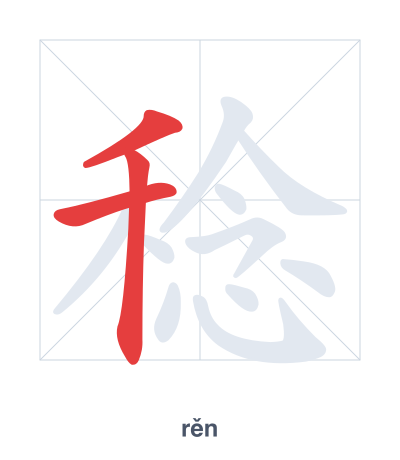
Open Hanzi Writer to see the animated stroke order and practice writing 稔 with real-time feedback.
The character 稔 (rěn) is written with 13 strokes. Follow the standard Chinese stroke order: top to bottom, left to right, outside before inside. The radical 禾 is one of its key components.
Practice the correct stroke order with the Hanzi Writer app to see animated stroke-by-stroke guidance with real-time feedback.
稔 means ripe; familiar with.
稔 is a phono-semantic compound with 禾 (grain) indicating the agricultural context and 念 (thought) providing the sound (though the pronunciation shifted to rěn). The original meaning 'ripe' refers to grain ready for harvest, and 'familiar' extends from the idea of something fully matured and well-known.
💡 Memory Tip: Imagine grain (禾) that is now (今) in the heart (心) of the farmer—so ripe and familiar it's stored in memory.
今年是一个丰稔年。
jīn nián shì yí gè fēng rěn nián
This year is a year of bumper crops.
我稔知他的性格。
wǒ rěn zhī tā de xìng gé
I am well acquainted with his character.
他们两人非常稔熟。
tā men liǎng rén fēi cháng rěn shú
The two of them are very well-acquainted.
Open Hanzi Writer to see the animated stroke order and practice writing 稔 with real-time feedback.
✨ Animated stroke order · Handwriting recognition · HSK-graded practice · Free to use
稔 combines the radical 禾 (grain) on the left and the character 念 (to read or think) on the right. The grain radical suggests harvest or crops, while 念 adds the idea of being known or understood; together they convey both "ripe" (grain ready to harvest) and "familiar" (something known well).