稗 (bài) means "barnyard grass; minor; unofficial" in Chinese. It has 13 strokes with the radical 禾.
Rated 4.2/5 in difficulty (advanced).
Appears in 3+ common words including 稗子 (bài zi), 稗草 (bài cǎo), 稗官野史 (bài guān yě shǐ).
Due to its 13 strokes, Hanzi Writer's error detection shows 稗 requires focused practice — most learners need 10+ attempts for consistent accuracy.
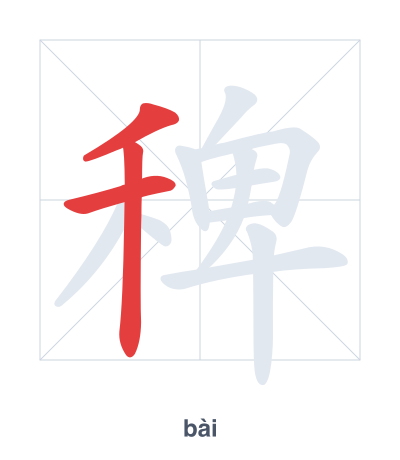
Open Hanzi Writer to see the animated stroke order and practice writing 稗 with real-time feedback.
The character 稗 (bài) is written with 13 strokes. Follow the standard Chinese stroke order: top to bottom, left to right, outside before inside. The radical 禾 is one of its key components.
Practice the correct stroke order with the Hanzi Writer app to see animated stroke-by-stroke guidance with real-time feedback.
稗 means barnyard grass; minor; unofficial.
稗 combines the radical 禾 (grain/plant) with 卑 (meaning low or humble), indicating a lowly weed that grows among rice fields. The character refers to barnyard grass, a common weed that mimics rice but is considered a minor, inferior plant.
💡 Memory Tip: Picture a lowly weed (禾) bowing down (卑) in shame because it's just a fake rice plant.
田里有很多稗子。
tián lǐ yǒu hěn duō bài zi
There are many barnyard grasses in the field.
农民在拔稗草。
nóng mín zài bá bài cǎo
Farmers are pulling up barnyard grass.
他喜欢看稗官野史。
tā xǐ huān kàn bài guān yě shǐ
He likes reading unofficial histories and anecdotes.
Open Hanzi Writer to see the animated stroke order and practice writing 稗 with real-time feedback.
✨ Animated stroke order · Handwriting recognition · HSK-graded practice · Free to use
稗 is composed of 禾 (grain) on the left and 卑 (low, humble) on the right. The radical 禾 shows it is a type of grass or plant, while 卑 suggests something lowly or minor, so together they mean 'barnyard grass' (a low weed) or 'unofficial.'