稙 (zhī) means "early-planted crops" in Chinese. It has 13 strokes with the radical 禾.
Rated 4.2/5 in difficulty (advanced).
Appears in 3+ common words including 稙禾 (zhī hé), 稙谷 (zhī gǔ), 稙庄稼 (zhī zhuāng jià).
Due to its 13 strokes, Hanzi Writer's error detection shows 稙 requires focused practice — most learners need 10+ attempts for consistent accuracy.
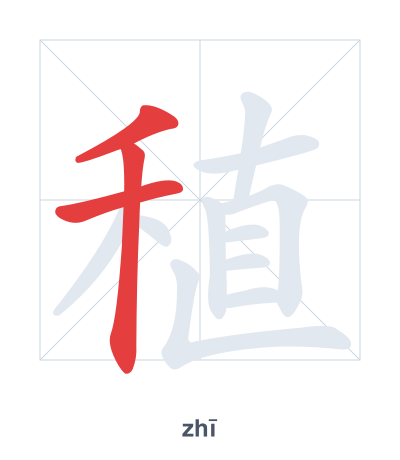
Open Hanzi Writer to see the animated stroke order and practice writing 稙 with real-time feedback.
The character 稙 (zhī) is written with 13 strokes. Follow the standard Chinese stroke order: top to bottom, left to right, outside before inside. The radical 禾 is one of its key components.
Practice the correct stroke order with the Hanzi Writer app to see animated stroke-by-stroke guidance with real-time feedback.
稙 means early-planted crops.
稙 combines the radical 禾 (grain/crops) with the phonetic component 直 (straight/upright). Early-planted crops often grow tall and straight because they get a head start on the growing season, and the character visually evokes a straight stalk of grain.
💡 Memory Tip: Picture a row of early-planted rice shoots (禾) standing perfectly straight (直) like little green soldiers, proudly showing they were sown first.
农民在种稙禾。
nóng mín zài zhǒng zhī hé
Farmers are planting early-ripening grain.
稙谷长得很快。
zhī gǔ zhǎng dé hěn kuài
Early-planted grain grows very fast.
稙庄稼需要水。
zhī zhuāng jià xū yào shuǐ
Planting crops early requires water.
Open Hanzi Writer to see the animated stroke order and practice writing 稙 with real-time feedback.
✨ Animated stroke order · Handwriting recognition · HSK-graded practice · Free to use
稙 is composed of the radical 禾 (grain) on the left and the phonetic component 直 (zhí, straight) on the right. The radical hints that the character relates to crops or grains, while the sound component suggests the pronunciation is close to zhī.