佳 (jiā) means "Good / Fine" in Chinese. It has 8 strokes with the radical 亻, and is HSK Level 6.
Rated 3.4/5 in difficulty (challenging).
Harder than 15% of HSK Level 6 characters.
Appears in 3+ common words including 最佳 (zuì jiā), 佳节 (jiā jié), 佳人 (jiā rén).
Due to its 8 strokes, Hanzi Writer's error detection shows 佳 requires focused practice — most learners need 10+ attempts for consistent accuracy.
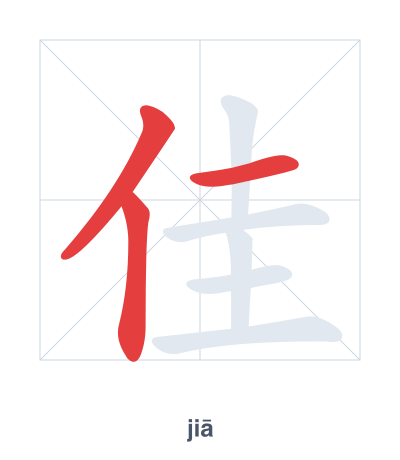
Open Hanzi Writer to see the animated stroke order and practice writing 佳 with real-time feedback.
The character 佳 (jiā) is written with 8 strokes. Follow the standard Chinese stroke order: top to bottom, left to right, outside before inside. The radical 亻 is one of its key components.
Practice the correct stroke order with the Hanzi Writer app to see animated stroke-by-stroke guidance with real-time feedback.
佳 means Good / Fine.
As an HSK Level 6 character, 佳 is an intermediate-level character.
佳 combines the radical 亻 (person) with the phonetic component 圭 (guī), which originally depicted a jade ritual tablet. The meaning 'good' or 'fine' likely stems from the cultural association of jade with virtue and excellence, implying a person of high quality.
💡 Memory Tip: Picture a person (亻) offering a precious jade tablet (圭) as a gift — that's a 'good' person doing a fine deed.
他是最佳人选。
tā shì zuì jiā rén xuǎn
He is the best candidate.
祝大家佳节快乐。
zhù dà jiā jiā jié kuài lè
Happy holidays to everyone.
才子配佳人。
cái zi pèi jiā rén
A gifted man matches a beautiful woman.
Open Hanzi Writer to see the animated stroke order and practice writing 佳 with real-time feedback.
✨ Animated stroke order · Handwriting recognition · HSK-graded practice · Free to use
佳 is made of the person radical 亻 on the left and the character 圭 (a jade tablet) on the right. The person radical suggests a human quality, while 圭 represents something precious and excellent, together forming the idea of a 'good' or 'fine' person. This structure helps explain why 佳 carries the meaning of excellence.