讽 (fěng) means "To satirize / To mock" in Chinese. It has 6 strokes with the radical 讠, and is HSK Level 7.
Rated 2.9/5 in difficulty (moderate).
Harder than 7% of HSK Level 7 characters.
Appears in 3+ common words including 讽刺 (fěng cì), 讽喻 (fěng yù), 嘲讽 (cháo fěng).
Hanzi Writer's stroke validation shows learners typically need 5-8 attempts to write 讽 with correct proportion and order.
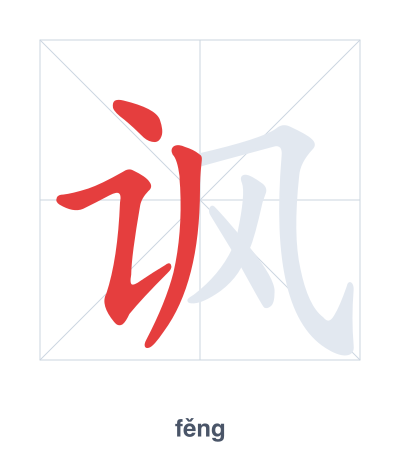
Open Hanzi Writer to see the animated stroke order and practice writing 讽 with real-time feedback.
The character 讽 (fěng) is written with 6 strokes. Follow the standard Chinese stroke order: top to bottom, left to right, outside before inside. The radical 讠 is one of its key components.
Practice the correct stroke order with the Hanzi Writer app to see animated stroke-by-stroke guidance with real-time feedback.
讽 means To satirize / To mock.
As an HSK Level 7 character, 讽 is an intermediate-level character.
This character is a phono-semantic compound: the radical 讠 (speech) indicates that the meaning relates to speaking, while 风 (fēng, wind) provides the pronunciation. The original meaning was to recite or chant, but it later evolved to imply a sharp, indirect criticism like a biting wind that satirizes or mocks.
💡 Memory Tip: Picture a speaker (讠) blowing a gust of wind (风) that carries mocking whispers to satirize someone.
他在讽刺我吗?
tā zài fěng cì wǒ ma
Is he mocking me?
这个故事很有讽喻性。
zhè ge gù shì hěn yǒu fěng yù xìng
This story is very allegorical.
别嘲讽别人。
bié cháo fěng bié rén
Don't mock others.
Open Hanzi Writer to see the animated stroke order and practice writing 讽 with real-time feedback.
✨ Animated stroke order · Handwriting recognition · HSK-graded practice · Free to use
The left component is the radical 讠, which means 'speech' or 'words'. The right component is 风 (fēng, wind), hinting that the mockery can spread quickly like wind—so 讽 combines words and wind to mean 'to mock' or 'to satirize'.