讫 (qì) means "Completed or finished" in Chinese. It has 5 strokes with the radical 讠.
Rated 2.7/5 in difficulty (moderate).
Appears in 3+ common words including 收讫 (shōu qì), 付讫 (fù qì), 验讫 (yàn qì).
Hanzi Writer's stroke validation shows learners typically need 5-8 attempts to write 讫 with correct proportion and order.
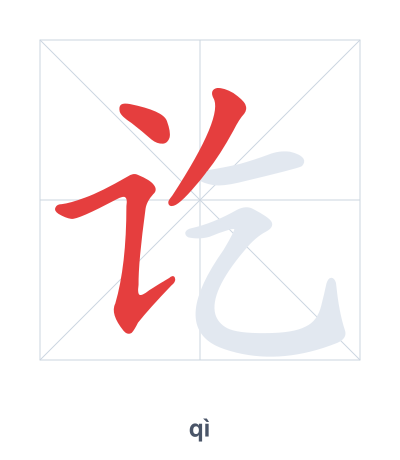
Open Hanzi Writer to see the animated stroke order and practice writing 讫 with real-time feedback.
The character 讫 (qì) is written with 5 strokes. Follow the standard Chinese stroke order: top to bottom, left to right, outside before inside. The radical 讠 is one of its key components.
Practice the correct stroke order with the Hanzi Writer app to see animated stroke-by-stroke guidance with real-time feedback.
讫 means Completed or finished.
讫 combines the speech radical 讠 (words) with 乞 (qì, 'to beg') as a phonetic hint, suggesting the conclusion of a spoken request or the moment when words are finished.
💡 Memory Tip: Picture a speaker (讠) raising their hand (乞's shape like a bent arm) to signal 'I'm done!'
现金收讫。
xiàn jīn shōu qì
Cash received.
账单已经付讫。
zhàng dān yǐ jīng fù qì
The bill has been paid in full.
货物已经验讫。
huò wù yǐ jīng yàn qì
The goods have been inspected and verified.
Open Hanzi Writer to see the animated stroke order and practice writing 讫 with real-time feedback.
✨ Animated stroke order · Handwriting recognition · HSK-graded practice · Free to use
讫 is made of the radical 讠 (speech) on the left and 乞 (qǐ) on the right. The 讠 links the character to words or speaking, and 乞 gives a hint for pronunciation qì. Together they suggest finishing something, like completing a statement or transaction.