奇 (jī/qí) means "strange / unusual / wonderful" in Chinese. It has 8 strokes with the radical 大, and is HSK Level 3.
Rated 3.7/5 in difficulty (challenging).
Harder than 47% of HSK Level 3 characters.
Appears in 4+ common words including 奇怪 (qí guài), 奇妙 (qí miào), 奇数 (jī shù).
Due to its 8 strokes, Hanzi Writer's error detection shows 奇 requires focused practice — most learners need 10+ attempts for consistent accuracy.
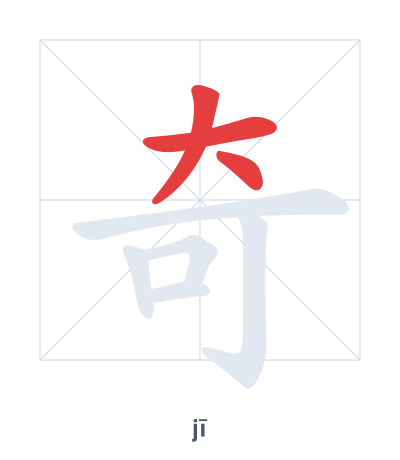
Open Hanzi Writer to see the animated stroke order and practice writing 奇 with real-time feedback.
The character 奇 (jī/qí) is written with 8 strokes. Follow the standard Chinese stroke order: top to bottom, left to right, outside before inside. The radical 大 is one of its key components.
Practice the correct stroke order with the Hanzi Writer app to see animated stroke-by-stroke guidance with real-time feedback.
奇 means strange / unusual / wonderful.
This is a polyphonic character with readings: jī, qí.
As an HSK Level 3 character, 奇 is an intermediate-level character.
奇 is a compound character where 大 (big) and 可 (can) combine to suggest something that is unusually large or possible in a strange way. Its ancient form may have depicted a person riding a horse, highlighting the unusual posture.
💡 Memory Tip: Imagine a huge (大) creature that can (可) talk — how strange and wonderful!
这种植物长得非常奇怪,我从没见过。
zhè zhòng zhí wù zhǎng dé fēi cháng qí guài wǒ cóng méi jiàn guò
This plant looks very strange; I've never seen it before.
大自然中有许多奇妙的景观等待探索。
dà zì rán zhōng yǒu xǔ duō qí miào de jǐng guān děng dài tàn suǒ
There are many wonderful landscapes in nature waiting to be explored.
在数学中,一、三、五都是奇数。
zài shù xué zhōng yī sān wǔ dōu shì jī shù
In mathematics, one, three, and five are all odd numbers.
结算后的奇零小钱,老板就给免了。
jié suàn hòu de jī líng xiǎo qián lǎo bǎn jiù gěi miǎn le
The boss waived the small change left over after the settlement.
Open Hanzi Writer to see the animated stroke order and practice writing 奇 with real-time feedback.
✨ Animated stroke order · Handwriting recognition · HSK-graded practice · Free to use
奇 is made of two parts: the radical 大 (big) on top and 可 (can) on the bottom. The big component suggests something out of the ordinary, while 可 provides a sound clue. Together they create the idea of something "strange" or "unusual."