怪 (guài) means "strange; weird; to blame" in Chinese. It has 8 strokes with the radical 忄, and is HSK Level 3.
Rated 3.7/5 in difficulty (challenging).
Harder than 50% of HSK Level 3 characters.
Appears in 3+ common words including 奇怪 (qí guài), 怪物 (guài wù), 责怪 (zé guài).
Due to its 8 strokes, Hanzi Writer's error detection shows 怪 requires focused practice — most learners need 10+ attempts for consistent accuracy.
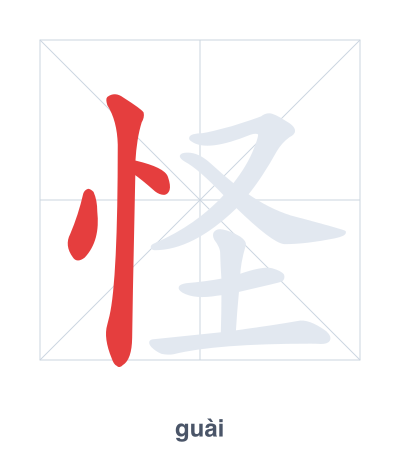
Open Hanzi Writer to see the animated stroke order and practice writing 怪 with real-time feedback.
The character 怪 (guài) is written with 8 strokes. Follow the standard Chinese stroke order: top to bottom, left to right, outside before inside. The radical 忄 is one of its key components.
Practice the correct stroke order with the Hanzi Writer app to see animated stroke-by-stroke guidance with real-time feedback.
怪 means strange; weird; to blame.
As an HSK Level 3 character, 怪 is an intermediate-level character.
怪 is a phono-semantic compound: the heart radical 忄 (indicating emotion) combines with 圣 (guài), which provides phonetic value. It suggests that strangeness or blame is an emotional response to something unusual.
💡 Memory Tip: Picture a heart (忄) feeling strange when it sees a sage (圣) doing cartwheels.
这件事真奇怪。
zhè jiàn shì zhēn qí guài
This is really strange.
电影里有一个怪物。
diàn yǐng lǐ yǒu yí gè guài wù
There is a monster in the movie.
请不要责怪他。
qǐng bú yào zé guài tā
Please don't blame him.
Open Hanzi Writer to see the animated stroke order and practice writing 怪 with real-time feedback.
✨ Animated stroke order · Handwriting recognition · HSK-graded practice · Free to use
怪 is made of two parts: the left radical 忄 (heart) and the right part 圣 (guài). The heart radical connects to emotions like surprise or blame, while the right side gives the sound "guài" and suggests something unusual or abnormal.