荤 (hūn) means "meat or fish; non-vegetarian food" in Chinese. It has 9 strokes with the radical 艹.
Rated 4/5 in difficulty (challenging).
Appears in 3+ common words including 荤菜 (hūn cài), 荤素 (hūn sù), 吃荤 (chī hūn).
Due to its 9 strokes, Hanzi Writer's error detection shows 荤 requires focused practice — most learners need 10+ attempts for consistent accuracy.
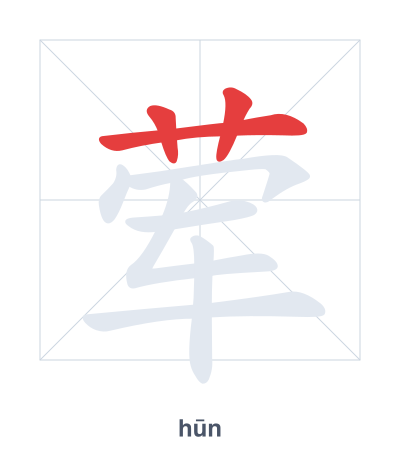
Open Hanzi Writer to see the animated stroke order and practice writing 荤 with real-time feedback.
The character 荤 (hūn) is written with 9 strokes. Follow the standard Chinese stroke order: top to bottom, left to right, outside before inside. The radical 艹 is one of its key components.
Practice the correct stroke order with the Hanzi Writer app to see animated stroke-by-stroke guidance with real-time feedback.
荤 means meat or fish; non-vegetarian food.
Originally referred to strong-smelling vegetables like garlic and onions, which Buddhist monks avoided. The radical 艹 (grass) hints at its plant origins, while the phonetic component 军 (army) provides sound. Later the meaning shifted to meat and fish, as both are avoided in strict vegetarian diets.
💡 Memory Tip: Picture an army (军) camped in the grass (艹) roasting meat over a fire.
我不喜欢吃荤菜。
wǒ bù xǐ huān chī hūn cài
I don't like eating meat dishes.
吃饭要荤素搭配。
chī fàn yào hūn sù dā pèi
Balance meat and vegetables in your diet.
他最近不吃荤。
tā zuì jìn bù chī hūn
He hasn't been eating meat lately.
Open Hanzi Writer to see the animated stroke order and practice writing 荤 with real-time feedback.
✨ Animated stroke order · Handwriting recognition · HSK-graded practice · Free to use
The character 荤 has the radical 艹 (grass) on top and 军 (army) below. The grass radical hints that 荤 originally meant strong-smelling vegetables, but now it means meat or non-vegetarian food. So the structure shows a plant origin that shifted to animal-based dishes.