芘 (pí) means "Pyrene (a chemical compound)" in Chinese. It has 7 strokes with the radical 艹.
Rated 3.5/5 in difficulty (challenging).
Appears in 2+ common words including 芘 (pí), 芘子 (pí zi).
Due to its 7 strokes, Hanzi Writer's error detection shows 芘 requires focused practice — most learners need 10+ attempts for consistent accuracy.
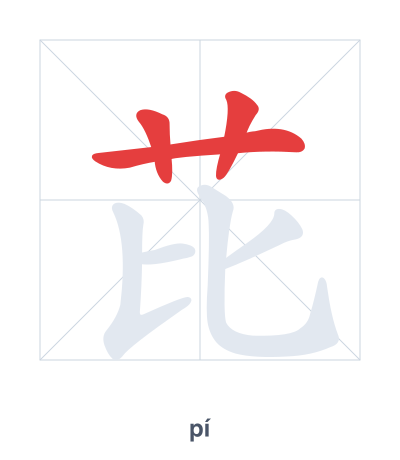
Open Hanzi Writer to see the animated stroke order and practice writing 芘 with real-time feedback.
The character 芘 (pí) is written with 7 strokes. Follow the standard Chinese stroke order: top to bottom, left to right, outside before inside. The radical 艹 is one of its key components.
Practice the correct stroke order with the Hanzi Writer app to see animated stroke-by-stroke guidance with real-time feedback.
芘 means Pyrene (a chemical compound).
芘 consists of the grass radical 艹 and the phonetic component 比 (bǐ). Originally meaning a type of herb, it was later borrowed as a transliteration for the chemical compound pyrene, with the grass radical hinting at its organic origin.
💡 Memory Tip: Picture a clover leaf (艹) with two identical halves (比) fused together, forming the four fused benzene rings of a pyrene molecule.
芘是一种化学物质。
pí shì yī zhǒng huà xué wù zhì
Pyrene is a chemical substance.
这种植物叫作芘子。
zhè zhòng zhí wù jiào zuò pí zi
This plant is called a castor bean.
他在实验室研究芘。
tā zài shí yàn shì yán jiū pí
He is studying pyrene in the laboratory.
Open Hanzi Writer to see the animated stroke order and practice writing 芘 with real-time feedback.
✨ Animated stroke order · Handwriting recognition · HSK-graded practice · Free to use
芘 is made of the radical 艹 (grass) on top and 比 (bǐ, meaning 'to compare') below. The 艹 radical indicates it is a type of plant-related substance or chemical compound, while 比 provides the pronunciation pí. This is common for chemical terms where the radical hints at the category of matter and the phonetic part gives the sound.