婚 (hūn) means "Marriage; to marry" in Chinese. It has 11 strokes with the radical 女, and is HSK Level 3.
Rated 4.2/5 in difficulty (advanced).
Harder than 73% of HSK Level 3 characters.
Appears in 3+ common words including 结婚 (jié hūn), 婚礼 (hūn lǐ), 订婚 (dìng hūn).
Due to its 11 strokes, Hanzi Writer's error detection shows 婚 requires focused practice — most learners need 10+ attempts for consistent accuracy.
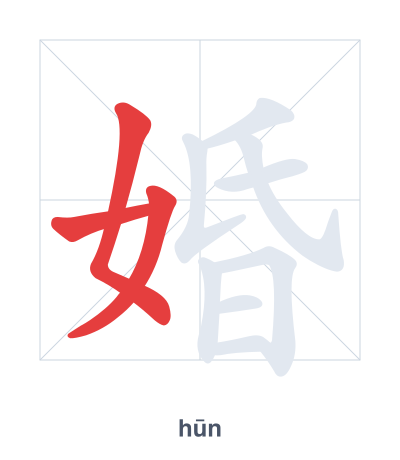
Open Hanzi Writer to see the animated stroke order and practice writing 婚 with real-time feedback.
The character 婚 (hūn) is written with 11 strokes. Follow the standard Chinese stroke order: top to bottom, left to right, outside before inside. The radical 女 is one of its key components.
Practice the correct stroke order with the Hanzi Writer app to see animated stroke-by-stroke guidance with real-time feedback.
婚 means Marriage; to marry.
As an HSK Level 3 character, 婚 is an intermediate-level character.
婚 combines the radical 女 (woman) with 昏 (dusk), because in ancient China weddings were traditionally held at dusk. The right component 昏 also provides the phonetic element hūn.
💡 Memory Tip: Picture a woman (女) saying 'I do' at dusk (昏) when the sun sets behind the horizon.
他们打算明年结婚。
tā men dǎ suàn míng nián jié hūn
They plan to get married next year.
婚礼在一家饭店举行。
hūn lǐ zài yī jiā fàn diàn jǔ xíng
The wedding ceremony is held in a restaurant.
他们上个月订婚了。
tā men shàng gè yuè dìng hūn le
They got engaged last month.
Open Hanzi Writer to see the animated stroke order and practice writing 婚 with real-time feedback.
✨ Animated stroke order · Handwriting recognition · HSK-graded practice · Free to use
婚 is a semantic-phonetic compound: the left radical 女 means 'woman,' and the right part 昏 (dusk) gives the sound hūn. Ancient Chinese weddings were traditionally held at dusk, so combining 'woman' with 'dusk' came to represent marriage.