哗 (huā/huá) means "Crash / Splash" in Chinese. It has 9 strokes with the radical 口, and is HSK Level 7.
Rated 4/5 in difficulty (challenging).
Harder than 38% of HSK Level 7 characters.
Appears in 3+ common words including 喧哗 (xuān huá), 哗变 (huá biàn), 哗啦 (huā lā).
Due to its 9 strokes, Hanzi Writer's error detection shows 哗 requires focused practice — most learners need 10+ attempts for consistent accuracy.
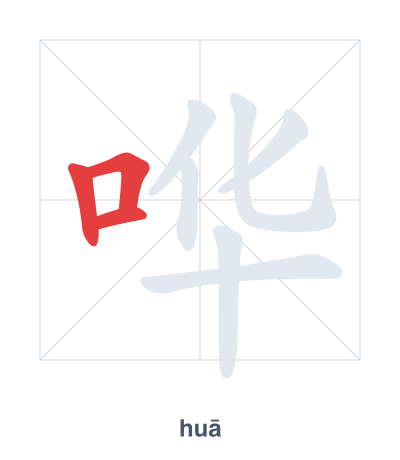
Open Hanzi Writer to see the animated stroke order and practice writing 哗 with real-time feedback.
The character 哗 (huā/huá) is written with 9 strokes. Follow the standard Chinese stroke order: top to bottom, left to right, outside before inside. The radical 口 is one of its key components.
Practice the correct stroke order with the Hanzi Writer app to see animated stroke-by-stroke guidance with real-time feedback.
哗 means Crash / Splash.
This is a polyphonic character with readings: huā, huá.
As an HSK Level 7 character, 哗 is an intermediate-level character.
哗 is a phono-semantic compound: the radical 口 (mouth) indicates a sound, while 华 (huá) provides the pronunciation. Together, they represent a loud noise like a crash or splash, as in the sound of breaking waves or a crowd's roar.
💡 Memory Tip: Picture a mouth (口) shouting 'Hua!' as a huge wave crashes and splashes loudly.
请大家保持安静,不要在图书馆里喧哗。
qǐng dà jiā bǎo chí ān jìng bú yào zài tú shū guǎn lǐ xuān huá
Please keep quiet and do not make noise in the library.
在残酷的统治下,驻守边关的士兵发生了哗变。
zài cán kù de tǒng zhì xià zhù shǒu biān guān dī shì bīng fā shēng le huá biàn
Under cruel rule, the soldiers stationed at the border mutinied.
玻璃瓶打碎在地上,发出了哗啦一声。
bō lí píng dǎ suì zài dì shàng fā chū le huā lā yī shēng
The glass bottle shattered on the ground with a crash.
Open Hanzi Writer to see the animated stroke order and practice writing 哗 with real-time feedback.
✨ Animated stroke order · Handwriting recognition · HSK-graded practice · Free to use
哗 is made of the radical 口 (mouth) on the left and 华 (huá) on the right. The 口 radical shows that this character relates to sound or the mouth, while 华 gives the pronunciation and adds the idea of something loud or showy. Together, they create the meaning of a crashing or splashing noise, like water or a crowd.