喊 (hǎn) means "to shout / to call out" in Chinese. It has 12 strokes with the radical 口, and is HSK Level 2.
Rated 3.7/5 in difficulty (challenging).
Harder than 71% of HSK Level 2 characters.
Appears in 3+ common words including 大喊 (dà hǎn), 喊人 (hǎn rén), 喊叫 (hǎn jiào).
Due to its 12 strokes, Hanzi Writer's error detection shows 喊 requires focused practice — most learners need 10+ attempts for consistent accuracy.
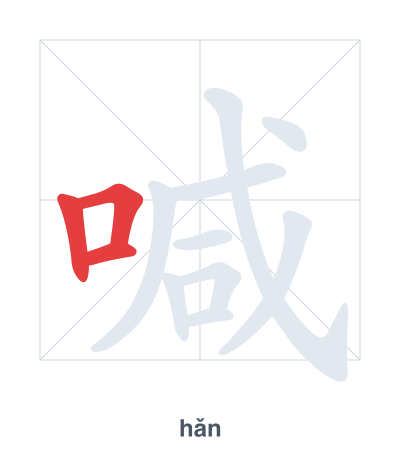
Open Hanzi Writer to see the animated stroke order and practice writing 喊 with real-time feedback.
The character 喊 (hǎn) is written with 12 strokes. Follow the standard Chinese stroke order: top to bottom, left to right, outside before inside. The radical 口 is one of its key components.
Practice the correct stroke order with the Hanzi Writer app to see animated stroke-by-stroke guidance with real-time feedback.
喊 means to shout / to call out.
As an HSK Level 2 character, 喊 is among the first characters beginners learn.
喊 combines the mouth radical 口 with the phonetic component 咸 (xián, originally 'salty' or 'all'). The mouth radical indicates the action involves the voice, while the phonetic gives the sound clue, creating a compound character meaning 'to shout' or 'call out' with a forceful, open-mouthed cry.
💡 Memory Tip: Picture a mouth (口) wide open, shouting 'HAAAA!' with a salty (咸) throat from yelling too long.
他对着大海大喊。
tā duì zhe dà hǎi dà hǎn
He shouted at the sea.
快去喊人来帮忙。
kuài qù hǎn rén lái bāng máng
Go quickly and call someone for help.
别在教室里喊叫。
bié zài jiào shì lǐ hǎn jiào
Don't shout in the classroom.
Open Hanzi Writer to see the animated stroke order and practice writing 喊 with real-time feedback.
✨ Animated stroke order · Handwriting recognition · HSK-graded practice · Free to use
喊 combines the radical 口 (mouth) on the left, which hints at actions done with the mouth, and the phonetic component 咸 (xián) on the right, which suggests the pronunciation. Together, they form a character meaning 'to shout' or 'to call out'—an action that uses the mouth.