稿 (gǎo) means "Draft; manuscript" in Chinese. It has 15 strokes with the radical 禾, and is HSK Level 6.
Rated 4.2/5 in difficulty (advanced).
Harder than 82% of HSK Level 6 characters.
Appears in 3+ common words including 稿子 (gǎo zi), 草稿 (cǎo gǎo), 投稿 (tóu gǎo).
Due to its 15 strokes, Hanzi Writer's error detection shows 稿 requires focused practice — most learners need 10+ attempts for consistent accuracy.
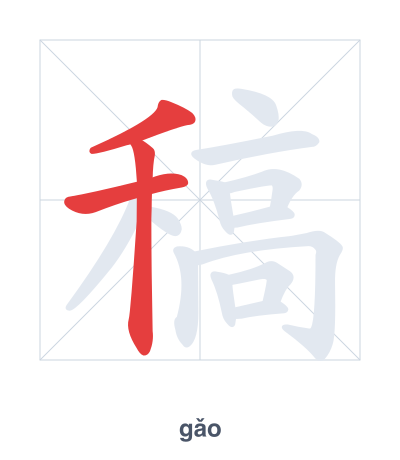
Open Hanzi Writer to see the animated stroke order and practice writing 稿 with real-time feedback.
The character 稿 (gǎo) is written with 15 strokes. Follow the standard Chinese stroke order: top to bottom, left to right, outside before inside. The radical 禾 is one of its key components.
Practice the correct stroke order with the Hanzi Writer app to see animated stroke-by-stroke guidance with real-time feedback.
稿 means Draft; manuscript.
As an HSK Level 6 character, 稿 is an intermediate-level character.
稿 combines the radical 禾 (grain/straw) with 高 (high, also phonetic). Originally it referred to the stalk of grain, and later came to mean a rough draft because ancient writers used cheap straw paper for preliminary writings.
💡 Memory Tip: Imagine a tall stalk of grain (禾) acting as a towering pen (高) scrawling a messy first draft on a piece of paper.
他正在写稿子。
tā zhèng zài xiě gǎo zi
He is writing a manuscript.
这是我的草稿。
zhè shì wǒ de cǎo gǎo
This is my draft.
我想向报社投稿。
wǒ xiǎng xiàng bào shè tóu gǎo
I want to submit an article to the newspaper.
Open Hanzi Writer to see the animated stroke order and practice writing 稿 with real-time feedback.
✨ Animated stroke order · Handwriting recognition · HSK-graded practice · Free to use
The character 稿 is made of the radical 禾 (grain) on the left and 高 (tall) on the right. The 禾 radical originally connected it to grain or straw, because ancient drafts were written on paper made from straw. The right part 高 provides the pronunciation (gǎo) and also suggests something tall or stacked, like a pile of manuscript pages.