港 (gǎng) means "Port or harbor" in Chinese. It has 12 strokes with the radical 氵, and is HSK Level 6.
Rated 4.2/5 in difficulty (advanced).
Harder than 75% of HSK Level 6 characters.
Appears in 3+ common words including 香港 (xiāng gǎng), 港口 (gǎng kǒu), 港币 (gǎng bì).
Due to its 12 strokes, Hanzi Writer's error detection shows 港 requires focused practice — most learners need 10+ attempts for consistent accuracy.
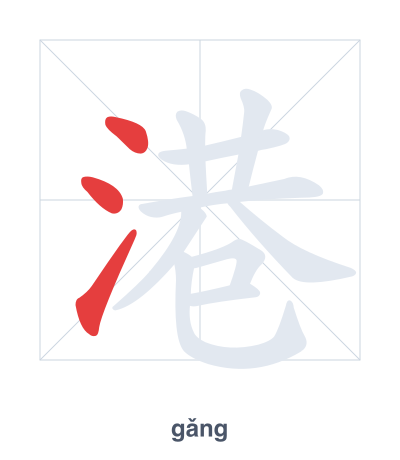
Open Hanzi Writer to see the animated stroke order and practice writing 港 with real-time feedback.
The character 港 (gǎng) is written with 12 strokes. Follow the standard Chinese stroke order: top to bottom, left to right, outside before inside. The radical 氵 is one of its key components.
Practice the correct stroke order with the Hanzi Writer app to see animated stroke-by-stroke guidance with real-time feedback.
港 means Port or harbor.
As an HSK Level 6 character, 港 is an intermediate-level character.
港 is a phono-semantic compound; the left radical 氵 (water) indicates its connection to harbors and waterways, while the right component 巷 (xiàng, 'lane/alley') gives a clue to its pronunciation (gǎng). Ancient references suggest 巷 originally depicted a winding path, which visually combines with water to evoke a sheltered inlet or dock where ships navigate narrow passages.
💡 Memory Tip: Imagine a busy harbor where the water (氵) flows into a winding lane (巷) shaped like a snake (巳), with boats docked side by side (共) along the pier.
我想去香港旅游。
wǒ xiǎng qù xiāng gǎng lǚ yóu
I want to travel to Hong Kong.
港口停着很多船。
gǎng kǒu tíng zhe hěn duō chuán
Many boats are docked at the port.
我换了一些港币。
wǒ huàn le yī xiē gǎng bì
I exchanged some Hong Kong dollars.
Open Hanzi Writer to see the animated stroke order and practice writing 港 with real-time feedback.
✨ Animated stroke order · Handwriting recognition · HSK-graded practice · Free to use
港 is made of the water radical 氵 on the left and the phonetic component 巷 on the right. The water radical suggests a place connected to water, and 巷 originally meant a lane or alley, so together they create the idea of a sheltered waterway — a port or harbor.