俘 (fú) means "to capture; prisoner of war" in Chinese. It has 9 strokes with the radical 亻, and is HSK Level 7.
Rated 3.7/5 in difficulty (challenging).
Harder than 22% of HSK Level 7 characters.
Appears in 3+ common words including 俘虏 (fú lǔ), 战俘 (zhàn fú), 被俘 (bèi fú).
Due to its 9 strokes, Hanzi Writer's error detection shows 俘 requires focused practice — most learners need 10+ attempts for consistent accuracy.
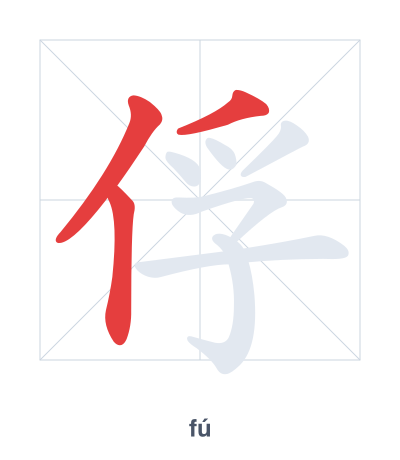
Open Hanzi Writer to see the animated stroke order and practice writing 俘 with real-time feedback.
The character 俘 (fú) is written with 9 strokes. Follow the standard Chinese stroke order: top to bottom, left to right, outside before inside. The radical 亻 is one of its key components.
Practice the correct stroke order with the Hanzi Writer app to see animated stroke-by-stroke guidance with real-time feedback.
俘 means to capture; prisoner of war.
As an HSK Level 7 character, 俘 is an intermediate-level character.
This character is a compound: the radical 亻 (person) on the left, and 孚 (fú) on the right, which originally depicted a hand (爫) grasping a child (子) — an image of seizing someone. Together 俘 conveys the meaning of capturing a person or a prisoner of war.
💡 Memory Tip: Picture a soldier (亻) using his hand (爫) to grab a child (子), taking him as a captive — that's 俘, 'to capture' or 'prisoner of war'.
士兵抓住了几个俘虏。
shì bīng zhuā zhù le jǐ gè fú lǔ
The soldier captured several prisoners.
战俘们回到了家乡。
zhàn fú men huí dào le jiā xiāng
The prisoners of war returned to their hometowns.
他在战斗中不幸被俘。
tā zài zhàn dòu zhōng bù xìng bèi fú
He was unfortunately captured in battle.
Open Hanzi Writer to see the animated stroke order and practice writing 俘 with real-time feedback.
✨ Animated stroke order · Handwriting recognition · HSK-graded practice · Free to use
The left side is 亻, meaning "person." The right side is 孚, which contains 爫 (a hand) and 子 (child), suggesting a hand grabbing a person — representing capture or a prisoner of war.