粪 (fèn) means "excrement; manure; dung" in Chinese. It has 12 strokes with the radical 米, and is HSK Level 7.
Rated 4.2/5 in difficulty (advanced).
Harder than 79% of HSK Level 7 characters.
Appears in 3+ common words including 粪便 (fèn biàn), 粪土 (fèn tǔ), 施粪 (shī fèn).
Due to its 12 strokes, Hanzi Writer's error detection shows 粪 requires focused practice — most learners need 10+ attempts for consistent accuracy.
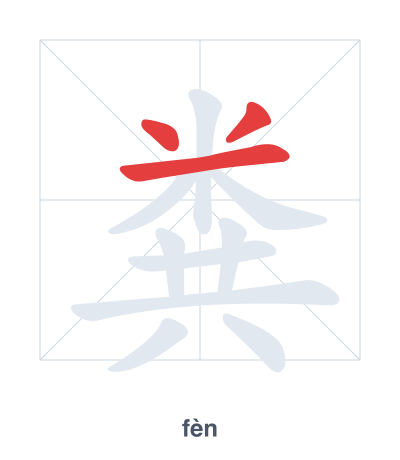
Open Hanzi Writer to see the animated stroke order and practice writing 粪 with real-time feedback.
The character 粪 (fèn) is written with 12 strokes. Follow the standard Chinese stroke order: top to bottom, left to right, outside before inside. The radical 米 is one of its key components.
Practice the correct stroke order with the Hanzi Writer app to see animated stroke-by-stroke guidance with real-time feedback.
粪 means excrement; manure; dung.
As an HSK Level 7 character, 粪 is an intermediate-level character.
Originally depicted a hand (廾) holding a broom sweeping away rice chaff or waste (米), symbolizing the removal of unwanted material. Over time, the character shifted to mean the waste itself—excrement or manure. The modern form combines 米 (rice/grain) with 廾 (two hands) and a horizontal stroke representing a container or the act of handling refuse.
💡 Memory Tip: Imagine two hands (廾) scooping a pile of stinky rice (米) that has turned into manure—you'd better hold your nose!
粪便可以作为农田肥料。
fèn biàn kě yǐ zuò wéi nóng tián féi liào
Excrement can be used as fertilizer for farmland.
他视金钱如粪土。
tā shì jīn qián rú fèn tǔ
He regards money as worthless.
农民正在给庄稼施粪。
nóng mín zhèng zài gěi zhuāng jià shī fèn
Farmers are applying manure to the crops.
Open Hanzi Writer to see the animated stroke order and practice writing 粪 with real-time feedback.
✨ Animated stroke order · Handwriting recognition · HSK-graded practice · Free to use
粪 is composed of the radical 米 (rice) on top, and a bottom part 共 (shared/common). The rice radical suggests organic matter, and the whole character evolved to mean excrement, which was historically used as manure in farming — a shared resource from rice consumption.