便 (biàn/pián) means "Convenient / Informal / Then" in Chinese. It has 9 strokes with the radical 亻, and is HSK Level 2.
Rated 3.2/5 in difficulty (challenging).
Harder than 43% of HSK Level 2 characters.
Appears in 3+ common words including 方便 (fāng biàn), 便宜行事 (biàn yí xíng shì), 便宜 (pián yi).
Due to its 9 strokes, Hanzi Writer's error detection shows 便 requires focused practice — most learners need 10+ attempts for consistent accuracy.
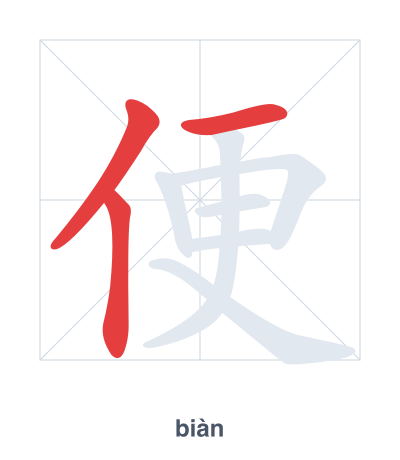
Open Hanzi Writer to see the animated stroke order and practice writing 便 with real-time feedback.
The character 便 (biàn/pián) is written with 9 strokes. Follow the standard Chinese stroke order: top to bottom, left to right, outside before inside. The radical 亻 is one of its key components.
Practice the correct stroke order with the Hanzi Writer app to see animated stroke-by-stroke guidance with real-time feedback.
便 means Convenient / Informal / Then.
This is a polyphonic character with readings: biàn, pián.
As an HSK Level 2 character, 便 is among the first characters beginners learn.
便 combines 亻 (person) and 更 (change). The original meaning was 'advantageous' or 'beneficial,' as in a person making a change that leads to convenience. Over time, it also came to mean 'informal' (a convenient manner) and 'then' (a logical transition).
💡 Memory Tip: Imagine a person (亻) who changes (更) their route to go to the bathroom, finding it convenient and then feeling relieved.
现在的移动支付非常方便,出门不用带钱包。
xiàn zài de yí dòng zhī fù fēi cháng fāng biàn chū mén bù yòng dài qián bāo
Mobile payment is very convenient nowadays; there's no need to carry a wallet when going out.
上级授权他在紧急情况下可以便宜行事。
shàng jí shòu quán tā zài jǐn jí qíng kuàng xià kě yǐ biàn yí xíng shì
His superiors authorized him to act as he sees fit in an emergency.
这家超市正在打折,很多商品都非常便宜。
zhè jiā chāo shì zhèng zài dǎ zhé hěn duō shāng pǐn dōu fēi cháng pián yi
This supermarket is having a sale; many items are very cheap.
Open Hanzi Writer to see the animated stroke order and practice writing 便 with real-time feedback.
✨ Animated stroke order · Handwriting recognition · HSK-graded practice · Free to use
便 is made of the radical 亻 (person) on the left and 更 (change) on the right. The combination suggests a person changing or adapting to make things convenient. This structural link helps explain the character's core meaning of 'convenient' or 'informal'.