返 (fǎn) means "to return; to go back" in Chinese. It has 7 strokes with the radical 辶, and is HSK Level 5.
Rated 3.5/5 in difficulty (challenging).
Harder than 28% of HSK Level 5 characters.
Appears in 3+ common words including 返回 (fǎn huí), 往返 (wǎng fǎn), 返校 (fǎn xiào).
Due to its 7 strokes, Hanzi Writer's error detection shows 返 requires focused practice — most learners need 10+ attempts for consistent accuracy.
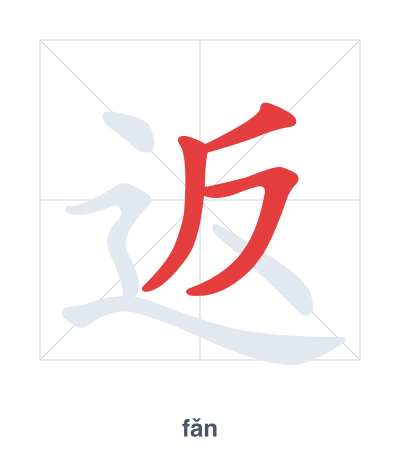
Open Hanzi Writer to see the animated stroke order and practice writing 返 with real-time feedback.
The character 返 (fǎn) is written with 7 strokes. Follow the standard Chinese stroke order: top to bottom, left to right, outside before inside. The radical 辶 is one of its key components.
Practice the correct stroke order with the Hanzi Writer app to see animated stroke-by-stroke guidance with real-time feedback.
返 means to return; to go back.
As an HSK Level 5 character, 返 is an intermediate-level character.
返 combines the radical 辶 (walking path) with 反 (reverse/opposite). The component 反 originated as a hand (又) pushing against a cliff (厂), conveying the idea of turning back or opposing. Together, 返 literally means 'to walk in reverse' — to go back or return.
💡 Memory Tip: Picture yourself walking (辶) along a path, then suddenly your hand (又) flips a sign (厂) that says 'wrong way,' so you turn around and return.
他已经返回北京了。
tā yǐ jīng fǎn huí běi jīng le
He has already returned to Beijing.
我买了一张往返机票。
wǒ mǎi le yī zhāng wǎng fǎn jī piào
I bought a round-trip plane ticket.
学生们下周一返校。
xué shēng men xià zhōu yī fǎn xiào
The students will return to school next Monday.
Open Hanzi Writer to see the animated stroke order and practice writing 返 with real-time feedback.
✨ Animated stroke order · Handwriting recognition · HSK-graded practice · Free to use
返 consists of the radical 辶 (walking) on the left and 反 (fǎn, meaning reverse or opposite) on the right. Together, they suggest 'walking in the opposite direction,' which means to return or go back.