阀 (fá) means "Valve; powerful family or clique" in Chinese. It has 9 strokes with the radical 门, and is HSK Level 7.
Rated 4/5 in difficulty (challenging).
Harder than 47% of HSK Level 7 characters.
Appears in 3+ common words including 阀门 (fá mén), 财阀 (cái fá), 军阀 (jūn fá).
Due to its 9 strokes, Hanzi Writer's error detection shows 阀 requires focused practice — most learners need 10+ attempts for consistent accuracy.
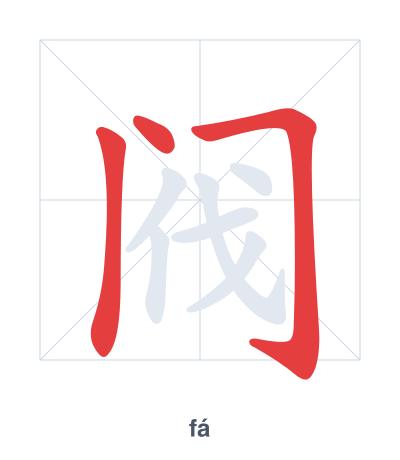
Open Hanzi Writer to see the animated stroke order and practice writing 阀 with real-time feedback.
The character 阀 (fá) is written with 9 strokes. Follow the standard Chinese stroke order: top to bottom, left to right, outside before inside. The radical 门 is one of its key components.
Practice the correct stroke order with the Hanzi Writer app to see animated stroke-by-stroke guidance with real-time feedback.
阀 means Valve; powerful family or clique.
As an HSK Level 7 character, 阀 is an intermediate-level character.
The character 阀 combines the radical 门 (gate/door) with 伐 (fá, meaning 'to cut' or 'attack'). In ancient China, a powerful family's gate was often guarded by armed retainers, so the compound suggests a gate controlled by force, evolving to mean 'valve' (a device that gates flow) and 'powerful clique' (a gated group). The 伐 component also provides phonetic information for the pronunciation fá.
💡 Memory Tip: Picture a fancy gate (门) where a guard with a halberd (person next to a halberd: 亻+戈 from 伐) stands watch, letting only the powerful family's water (or influence) pass through like a valve.
请关掉水管阀门。
qǐng guān diào shuǐ guǎn fá mén
Please turn off the water valve.
他来自一个大财阀。
tā lái zì yí gè dà cái fá
He comes from a large financial conglomerate.
历史书上有军阀。
lì shǐ shū shàng yǒu jūn fá
There are warlords in history books.
Open Hanzi Writer to see the animated stroke order and practice writing 阀 with real-time feedback.
✨ Animated stroke order · Handwriting recognition · HSK-graded practice · Free to use
阀 is made of the radical 门 (door/gate) on the outside and 伐 (fá, to cut) inside. The door radical suggests something that controls flow or entry, like a valve, while 伐 provides pronunciation. This combination also extends to powerful groups that control access or power, such as a warlord (军阀) or financial clique (财阀).