耴 (yì) means "appearance of ears (archaic)" in Chinese. It has 7 strokes with the radical 耳.
Rated 3.5/5 in difficulty (challenging).
Appears in 3+ common words including 耴耴 (yì yì), 耴字 (yì zì), 读音耴 (dú yīn yì).
Due to its 7 strokes, Hanzi Writer's error detection shows 耴 requires focused practice — most learners need 10+ attempts for consistent accuracy.
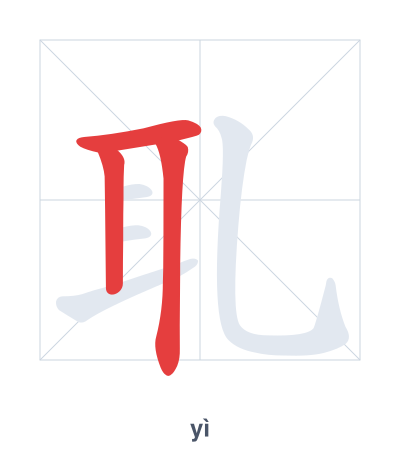
Open Hanzi Writer to see the animated stroke order and practice writing 耴 with real-time feedback.
The character 耴 (yì) is written with 7 strokes. Follow the standard Chinese stroke order: top to bottom, left to right, outside before inside. The radical 耳 is one of its key components.
Practice the correct stroke order with the Hanzi Writer app to see animated stroke-by-stroke guidance with real-time feedback.
耴 means appearance of ears (archaic).
| Character | 耴 |
| Pinyin | yì (yi) |
| Meaning | appearance of ears (archaic) |
| Strokes | 7 |
| Radical | 耳 |
| Difficulty | 3.5/5 |
This character is a pictograph depicting an ear (耳) with a distinctive curved stroke on the right, representing the unique shape or 'appearance' of an ear in ancient script. The component 乚 may symbolize a particular contour or feature of the ear's outer structure.
💡 Memory Tip: Picture an ear (耳) with a tiny hook (乚) hanging from it, like a quirky earring that shows off the ear's unusual appearance.
这个词在古书中出现。
zhè ge cí zài gǔ shū zhōng chū xiàn
This word appears in ancient books.
字典里可以查到耴字。
zì diǎn lǐ kě yǐ chá dào yì zì
The character '耴' can be found in the dictionary.
这个字的读音是耴。
zhè ge zì de dú yīn shì yì
The pronunciation of this character is 'yì'.
Open Hanzi Writer to see the animated stroke order and practice writing 耴 with real-time feedback.
✨ Animated stroke order · Handwriting recognition · HSK-graded practice · Free to use
The character 耴 is composed of the radical 耳 (ear) on the left and a simple hook-like stroke on the right. The left part shows the character belongs to the ear category, while the hook likely represents the curved shape of an ear's appearance. Together, they form the archaic meaning of "appearance of ears."